 Parcelles
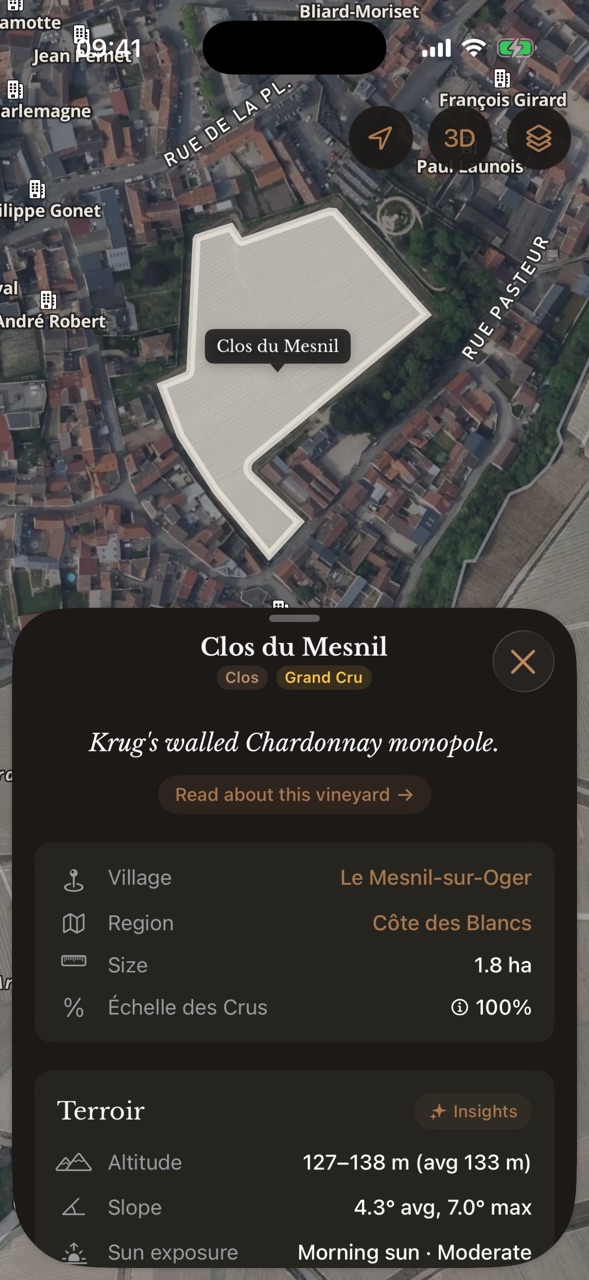
Walk through Le Mesnil-sur-Oger and you can miss it entirely: a stone wall like any garden's, a modest gate, a plaque. Inside is a vineyard of 1.84 hectares that has been enclosed since 1698, planted village-tight between houses, and its grapes go into one of the most expensive champagnes on earth. It is called Clos du Mesnil, and it is the most famous member of one of wine's smallest clubs: the walled vineyards of Champagne.
What a wall does
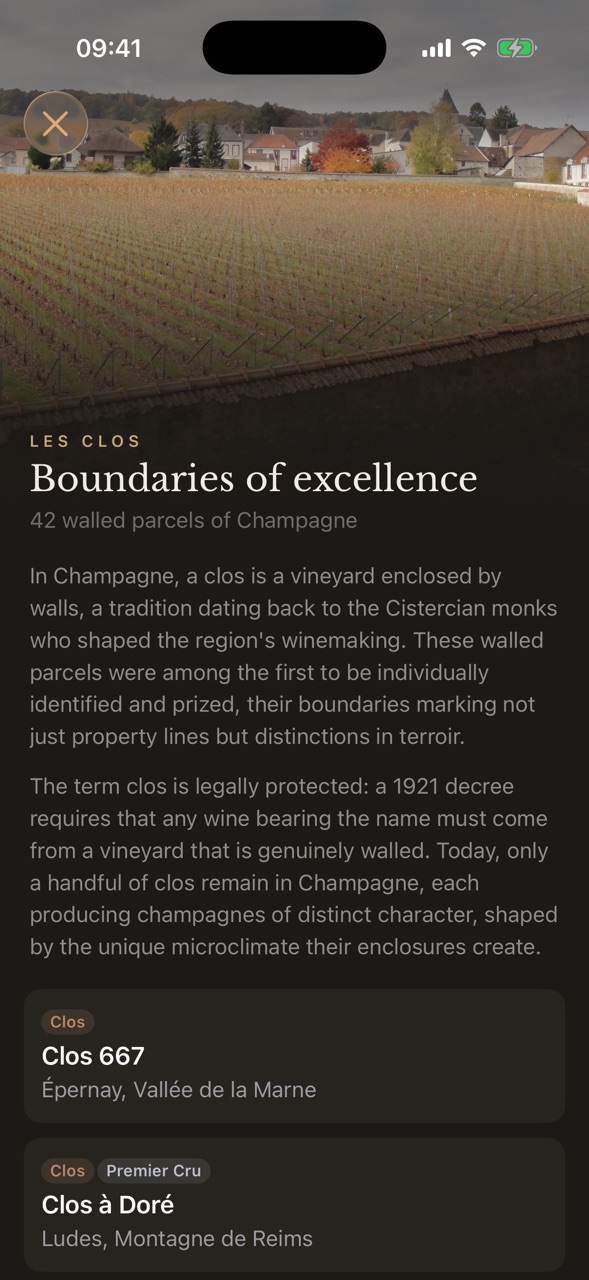
A clos, in the legal sense, is exactly what the French word says: an enclosure. To carry the name on a label, the vineyard must genuinely be walled, a requirement fixed by decree in 1921 and taken literally ever since. The walls were rarely built for poetry. Monasteries and landowners raised them centuries ago to mark ownership beyond argument, to keep out animals and thieves, and to shelter a precious crop in a climate that needed every advantage.
But the poetry arrived anyway, because a wall changes the wine. Stone absorbs the day's heat and gives it back at night, taking the edge off frost. It breaks the wind that chills flowering. It turns a plot of vines into a defined, nameable, bottleable place. In a region built on blending, across villages, across years, a clos is the opposite gesture: one enclosed piece of ground, one season, no place to hide.
Why Champagne has so few
Burgundy has hundreds of clos; Champagne, a few dozen, of which Parcelles curates the 42 most recognized, and fewer still are farmed and bottled as such. The difference is history's. Phylloxera forced the replanting of nearly every vineyard around the turn of the twentieth century, and walls fell to make room for rational rows. Then the First World War turned the region into a front line for four years: what artillery did to the villages of the Marne it also did to their stonework. Each reconstruction favoured consolidation, and a wall is an expensive thing to rebuild around a crop you are about to blend away anyway.
So the survivors are survivors twice over: once against economics, once against war. Most are tiny, many are inside or against the villages themselves (which is partly why they survived: town walls and garden walls did double duty), and nearly all are in the hands of growers or houses who understood, sooner than the market did, that an enclosed vineyard with a name is a story no blend can tell.
1.84 hectares of Chardonnay inside the village, walled since 1698. Krug's single-vineyard blanc de blancs made the clos idea world-famous.
Philipponnat's 5.8 hectare amphitheatre above the Marne canal, with slopes pitching up to 37 degrees, among the warmest sites in all Champagne.
0.68 hectares of Pinot Noir, one of the smallest and most expensive single vineyards in the region. Also Krug, first vintage 1995.
Billecart-Salmon's one hectare of Pinot Noir around the village church, farmed with horse and cover crops, a few thousand bottles a year.
Inside the walls
What the clos offer, beyond scarcity, is a controlled experiment that Champagne otherwise refuses to run. The region's genius is the blend: reserve wines smoothing the years, dozens of villages smoothing the map. A clos wine strips all of that away. One site, one year, often one grape. In a great season it is terroir with the volume turned all the way up; in a hard season there is nowhere to go, which is why several of the famous clos simply do not release anything in years the enclosure could not carry alone.
A region built on blending keeps a few walled exceptions, and the exceptions are how you taste what blending smooths away.
That is also what makes them useful to anyone learning the region, even from the outside of every gate. The clos are fixed points: named, bounded, unarguable. Taste two of them, or just study them on a map, and the abstraction of "terroir" acquires edges, an aspect, an elevation, a soil. The wall does for the mind what it does for the vines: it concentrates.
Finding them on the map
Most visitors drive past clos without knowing it; some of the most storied walls stand metres from a village bakery. They are easier to find as parcels than as monuments: an enclosed vineyard is, after all, just a vineyard with a boundary that means something. The recognized clos of Champagne are on the Parcelles map with their true outlines, and the walled names appear among each village's notable vineyards, so the next time you are in Ambonnay or Mareuil-sur-Aÿ, you can stand at the right wall on purpose.