Parcelles app icon Parcelles app icon

Parcelles

Champagne, decoded.

8,000 vineyard parcels. Millions of years of geology. Decades of climate data. One app that connects them all , from the chalk beneath the vines to the bottle in your hand.

Get the app

App Store Android, June 2026

One region, mapped in full

8,000+ parcels. One cartography.

Free

Explore the most detailed map of Champagne.

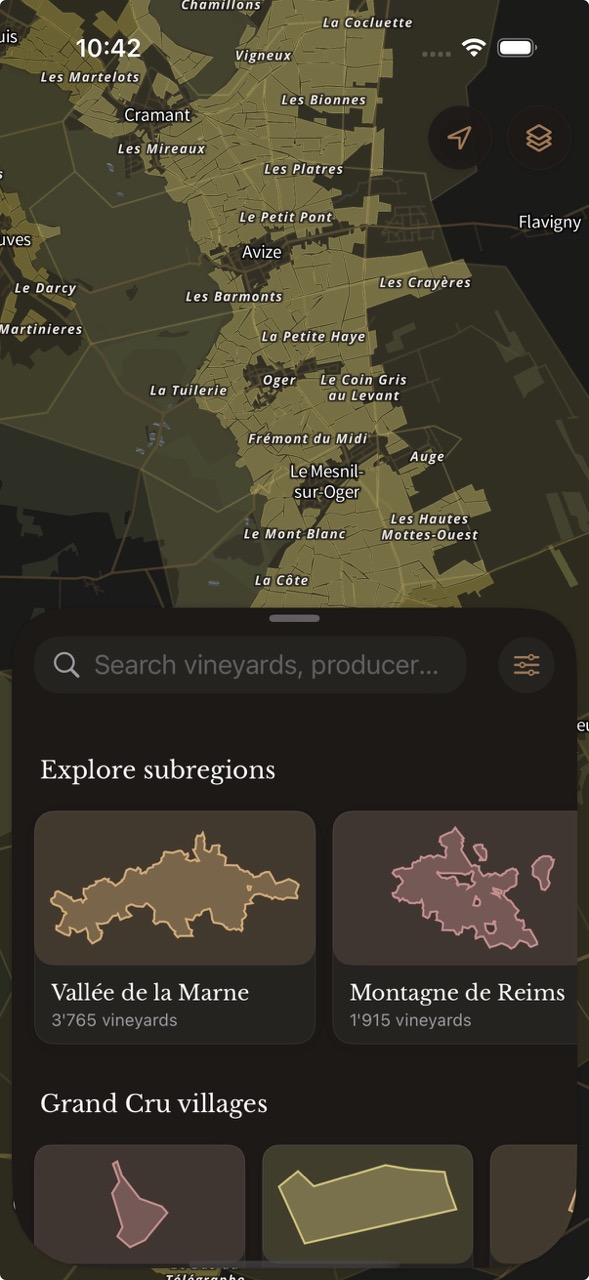
Every vineyard in Champagne, browsable and searchable. Subregions, villages, classifications. No account needed. No paywall for the basics.

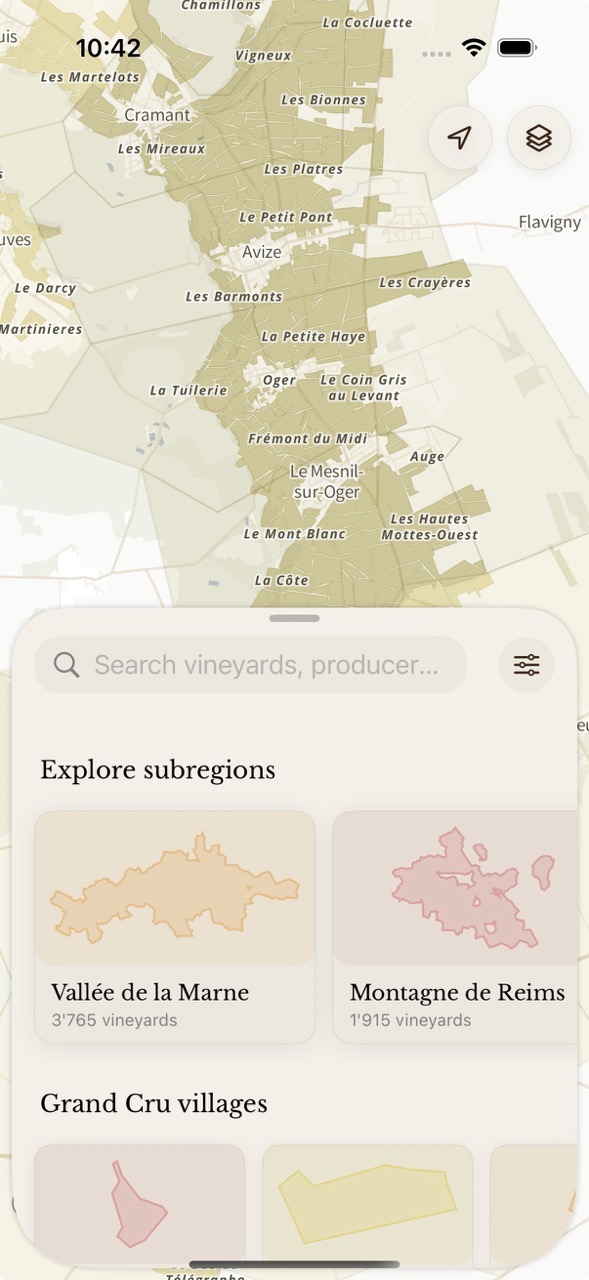
Interactive vineyard map

Explore over 8,000 parcels. Tap any vineyard to see its name, village, classification, and area.

Search anything

Find any vineyard, village, or producer instantly. Full-text search across the entire Champagne database.

Multiple map styles

Switch between cartography, standard, and satellite views. See the vineyards from every angle.
Interactive vineyard map Interactive vineyard map
Membership

Look beneath the surface

Membership unlocks the hidden dimensions of every vineyard: geological structures, soil composition, topography, exposure, and microclimate, plus full traceability from parcel to bottle.
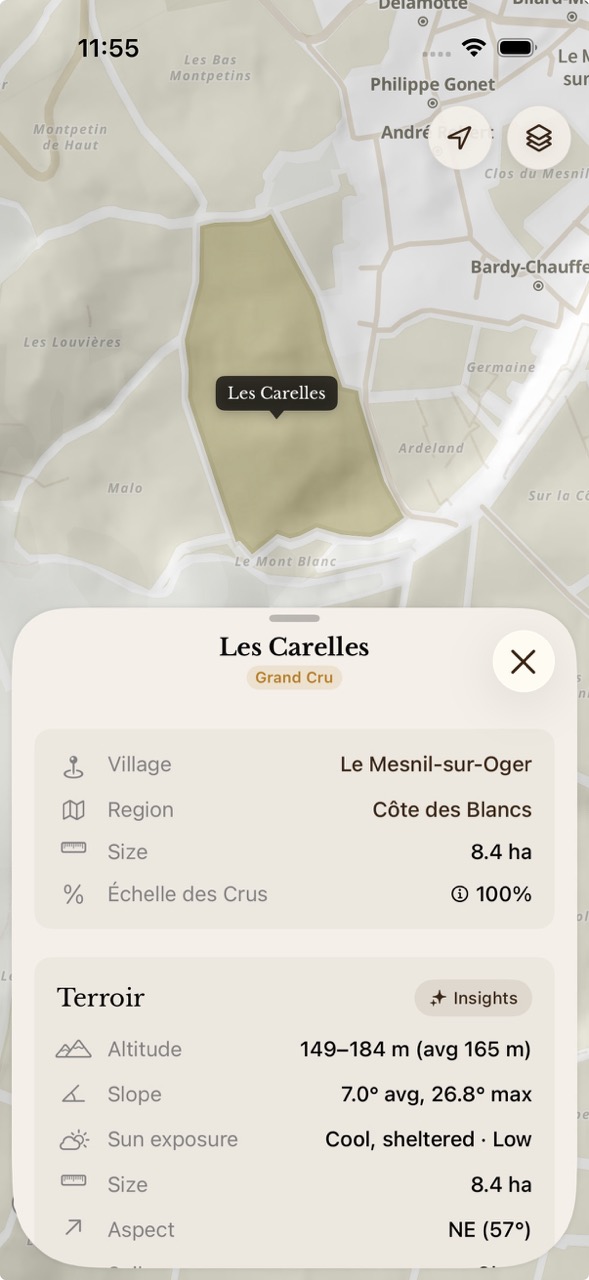
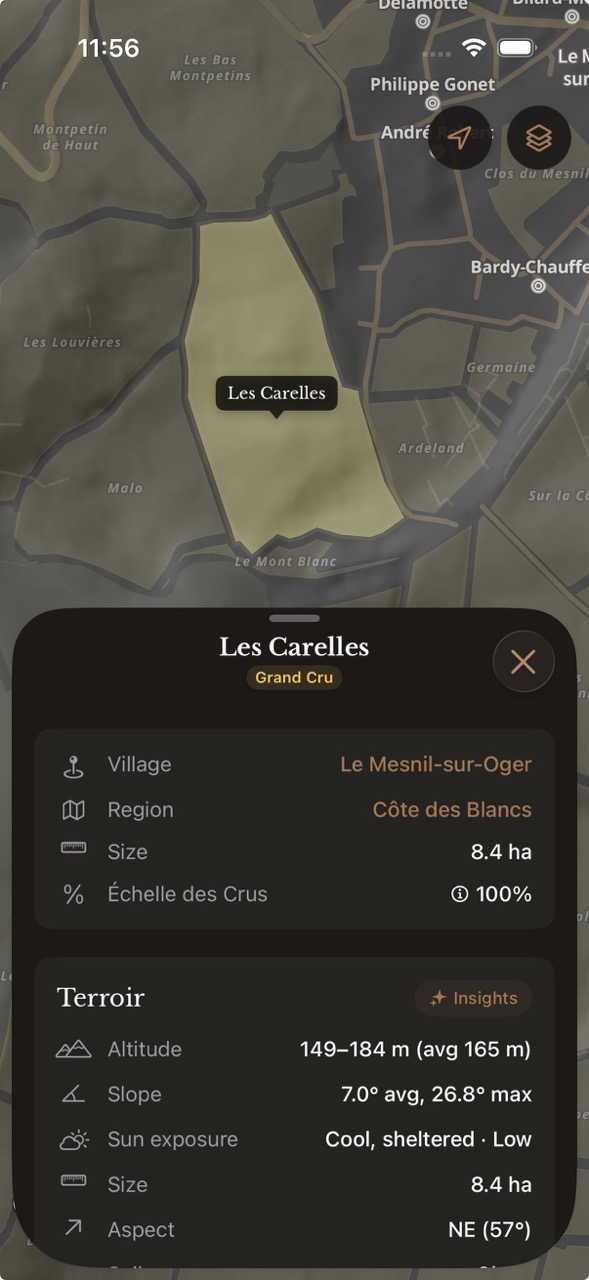
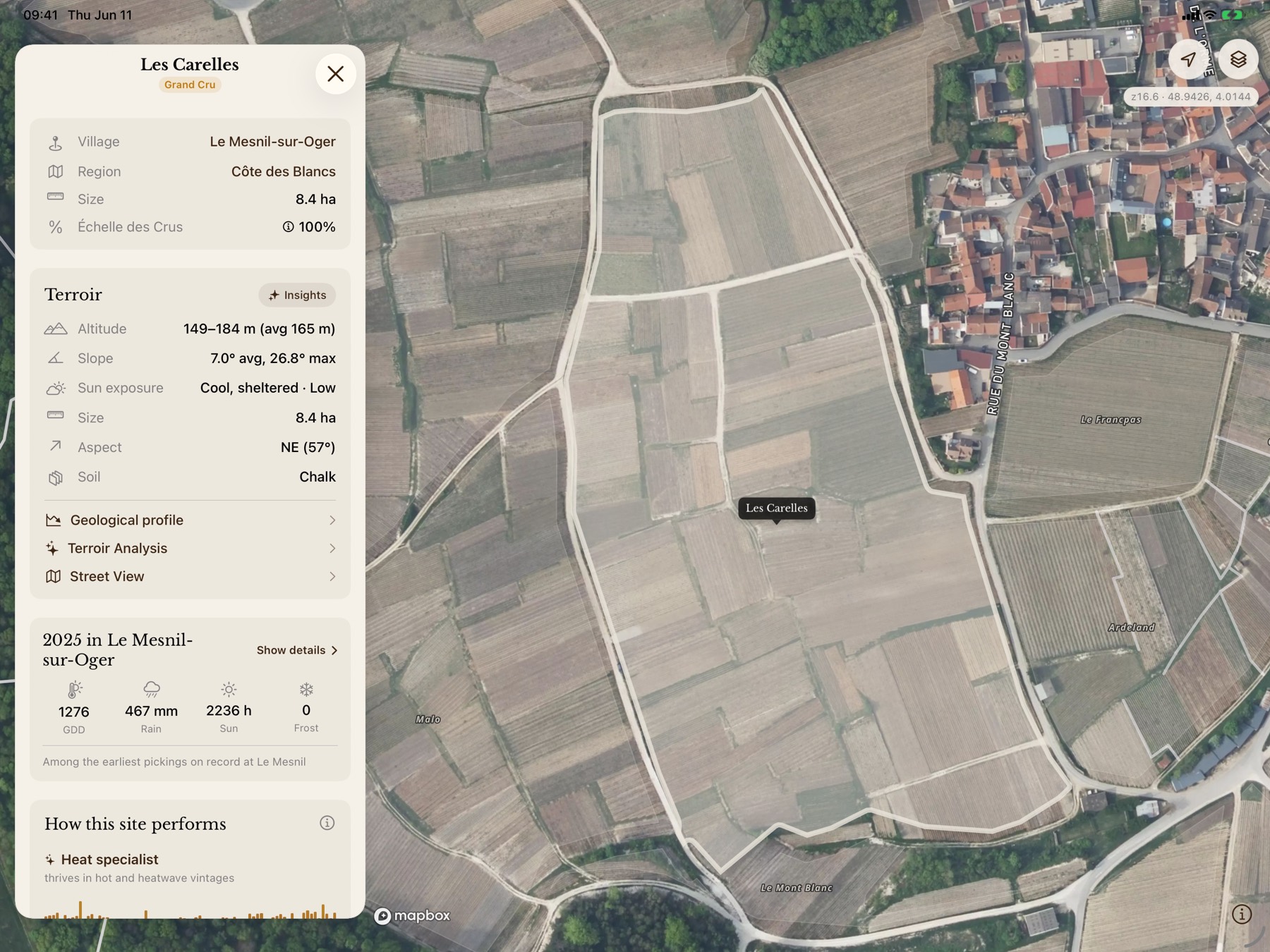
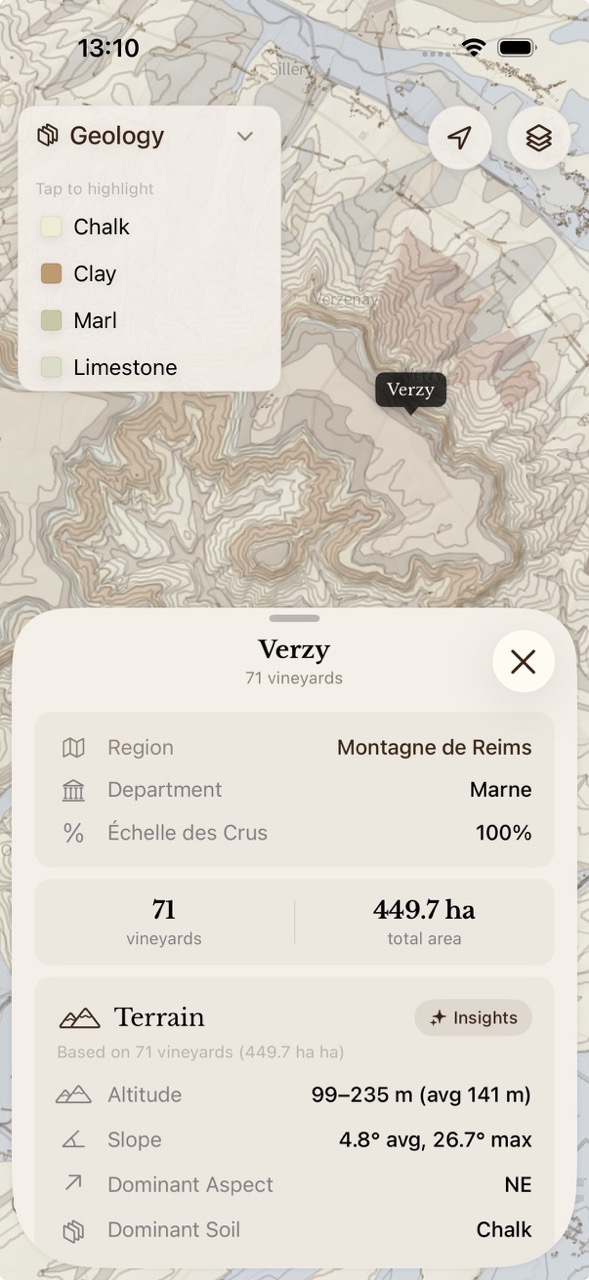
Terroir analysis Terroir analysis
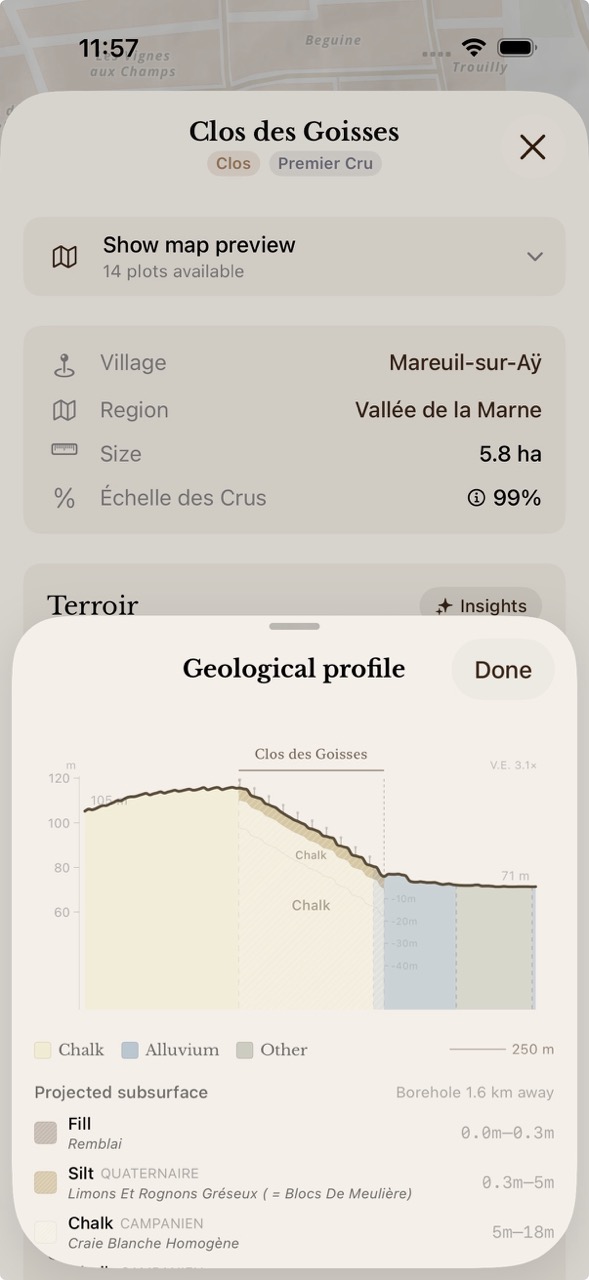
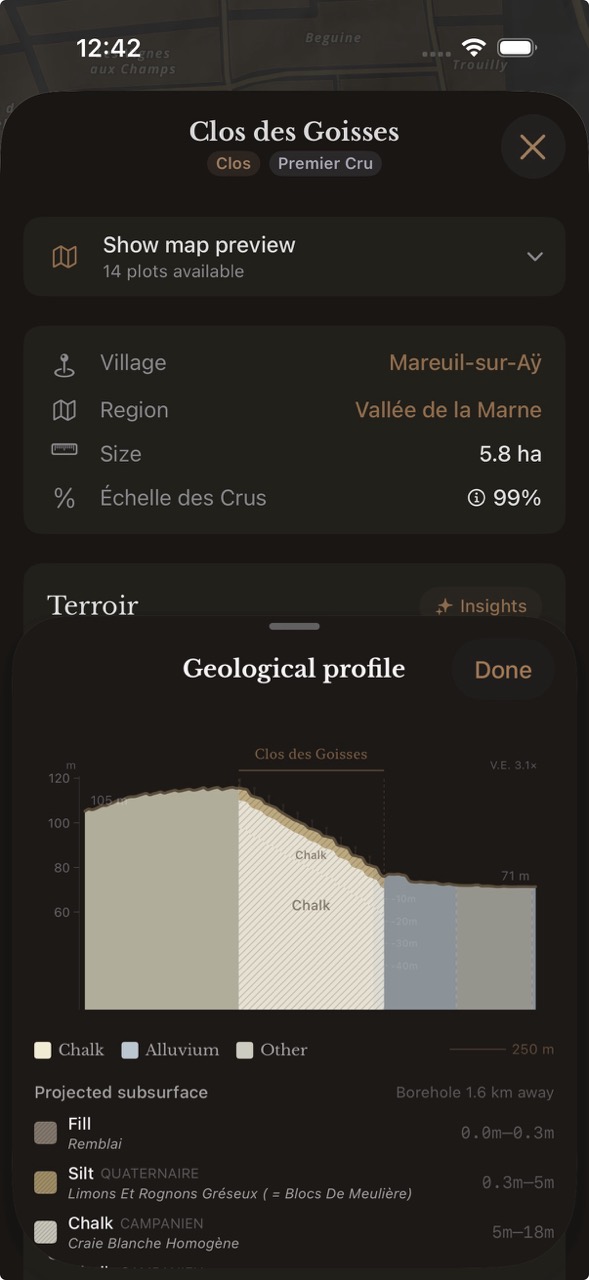
Elevation profile and geology Elevation profile and geology
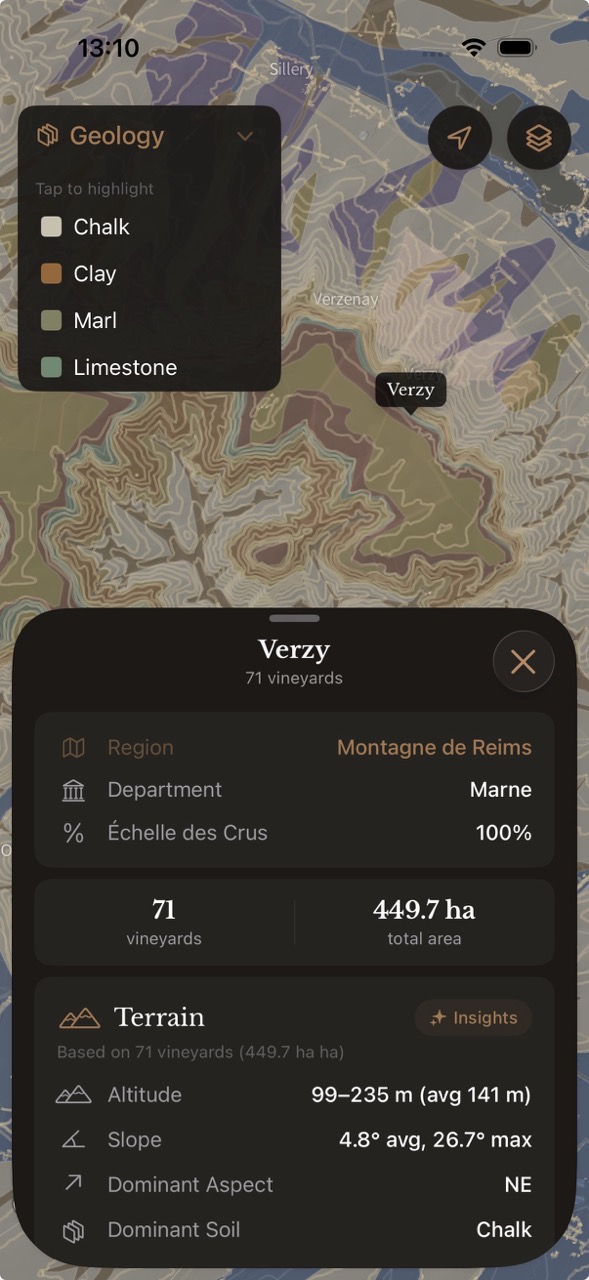
Terroir map overlays Terroir map overlays
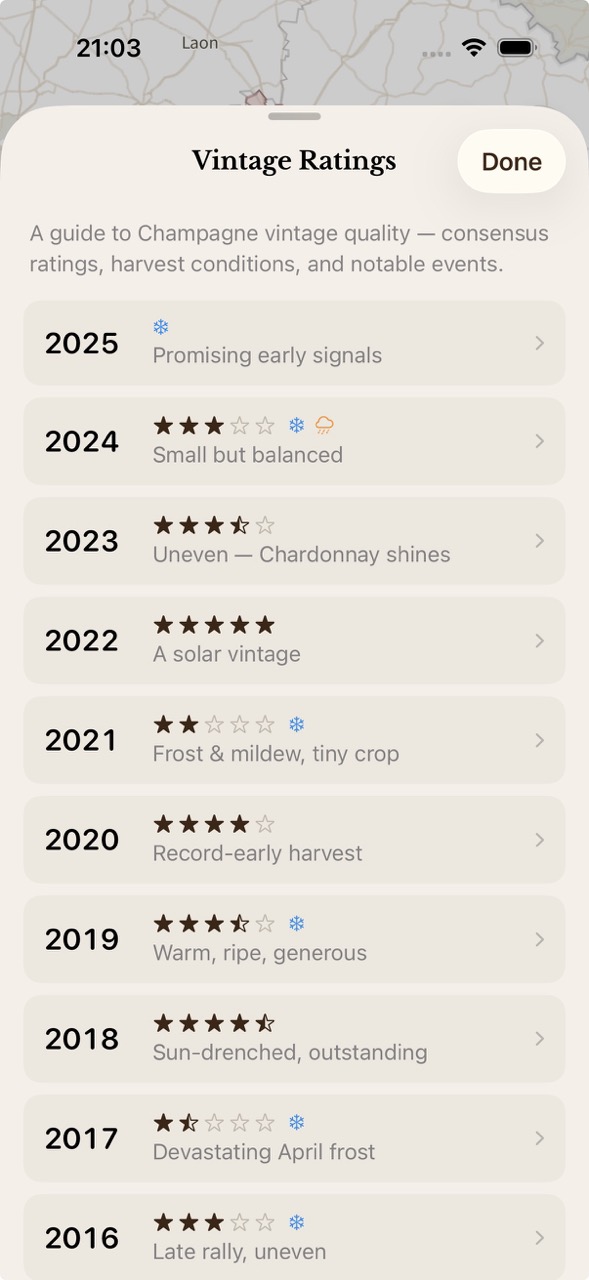
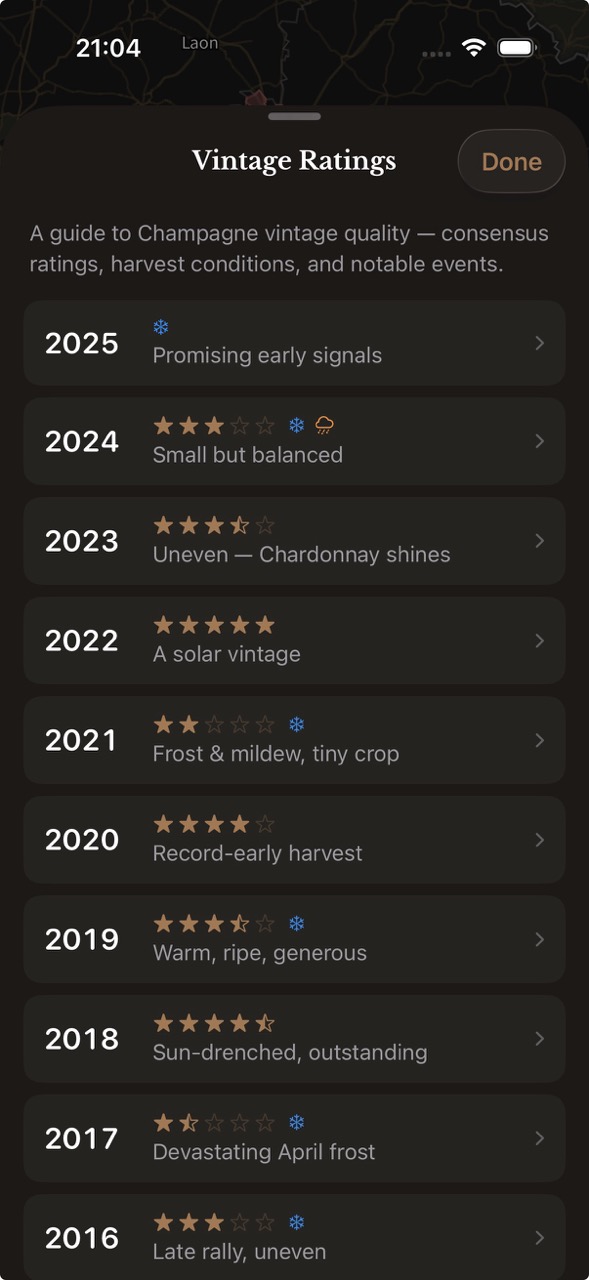
Vintage ratings Vintage ratings
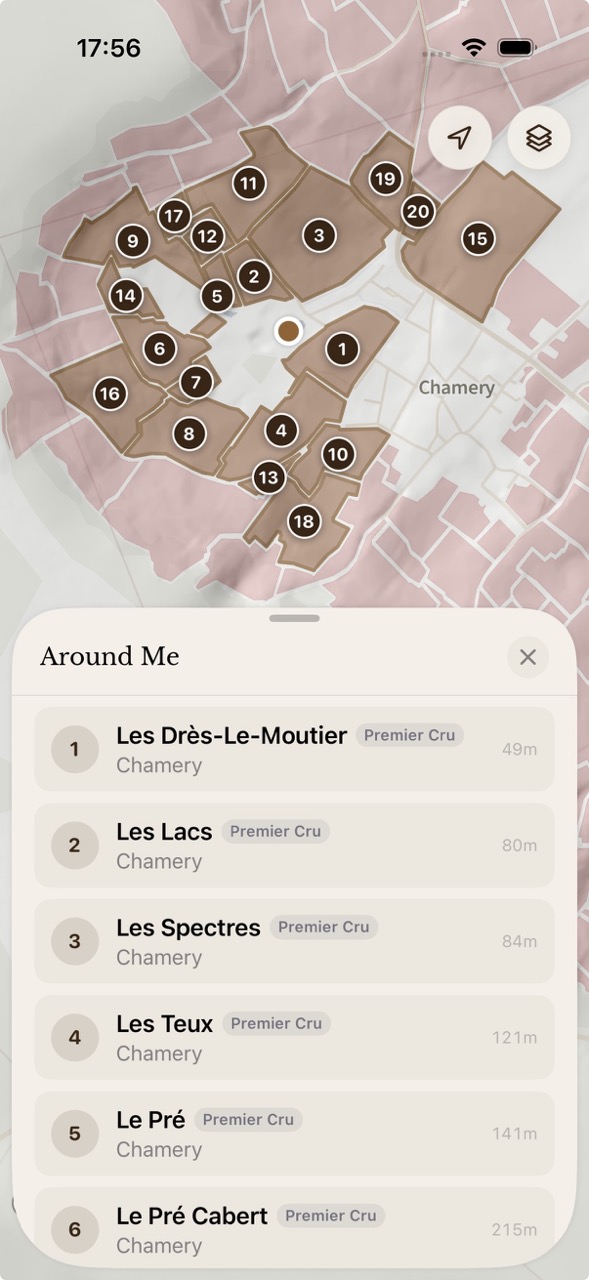
Around Me Around Me

Know the parcel

Every single vineyard profiled with altitude, slope, aspect, sun exposure, soil composition, and geology, ranked against all of Champagne. See exactly where each vineyard stands and what makes it unique.

Understand the landscape

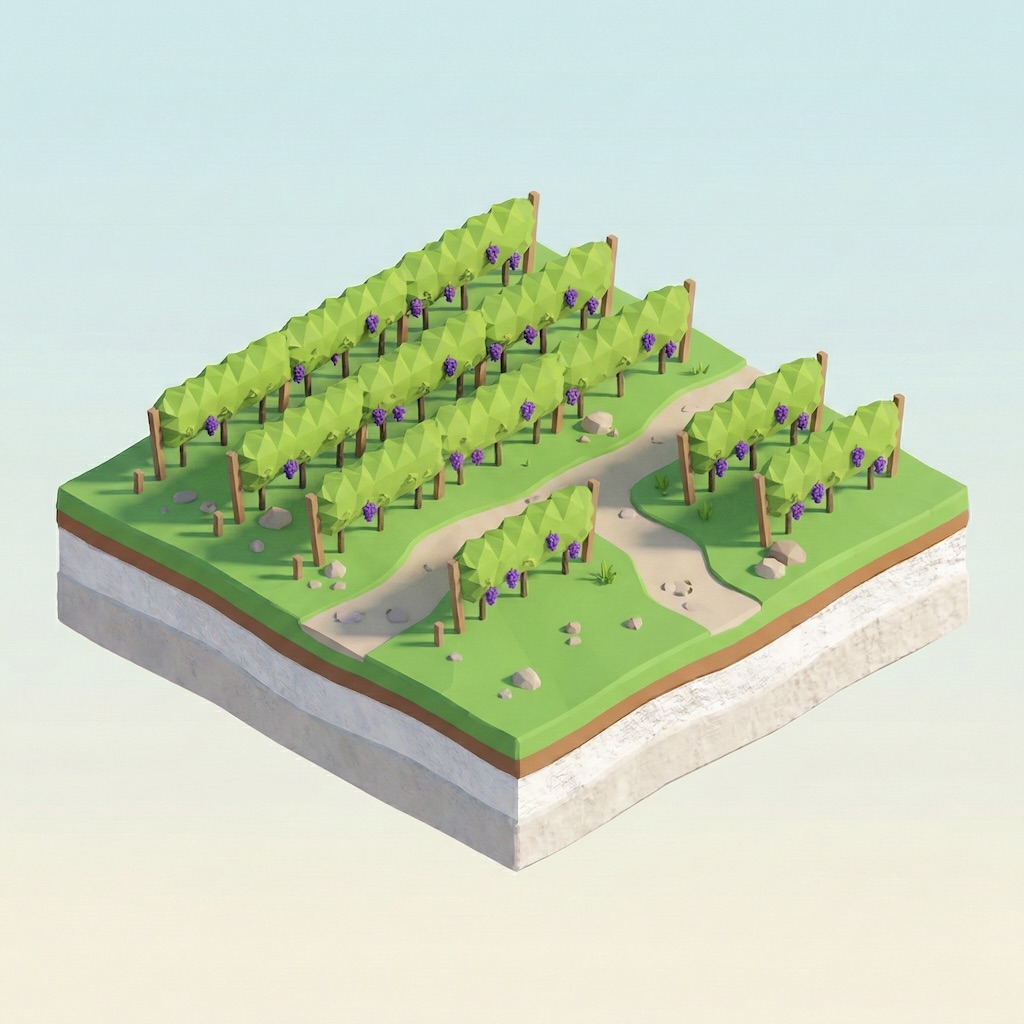
Elevation profiles with surface geology and projected underground rock layers reconstructed from boreholes. Hillshade, contour, and geology map overlays bring the terrain to life.

Discover the terroir

Geology, contour lines, hillshade, one tap, and the map reveals what lies beneath the vines.

Vintage ratings

Consensus quality ratings for every Champagne vintage back to 1950 , stars, harvest dates, frost and hail events at a glance.

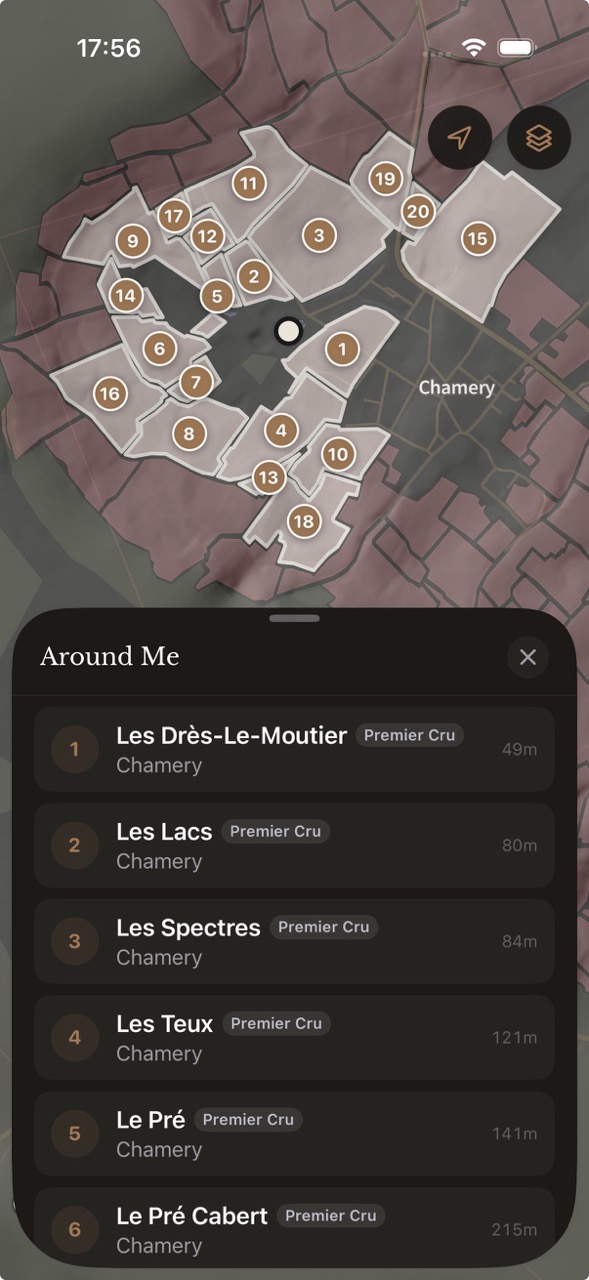
Around Me

Visiting Champagne? See which vineyards surround you in real time , numbered on the map and sorted by distance. Tap any parcel to dive straight into its terroir.

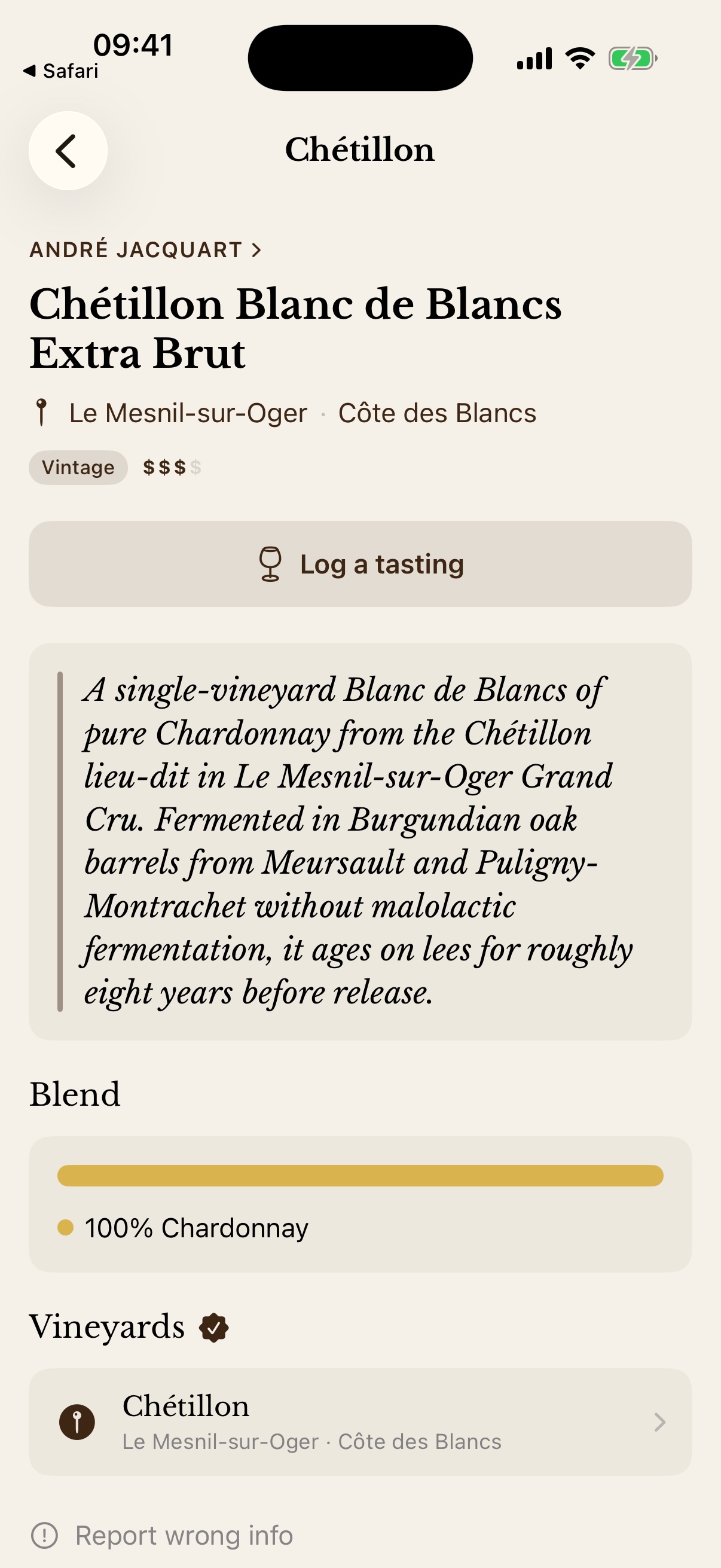
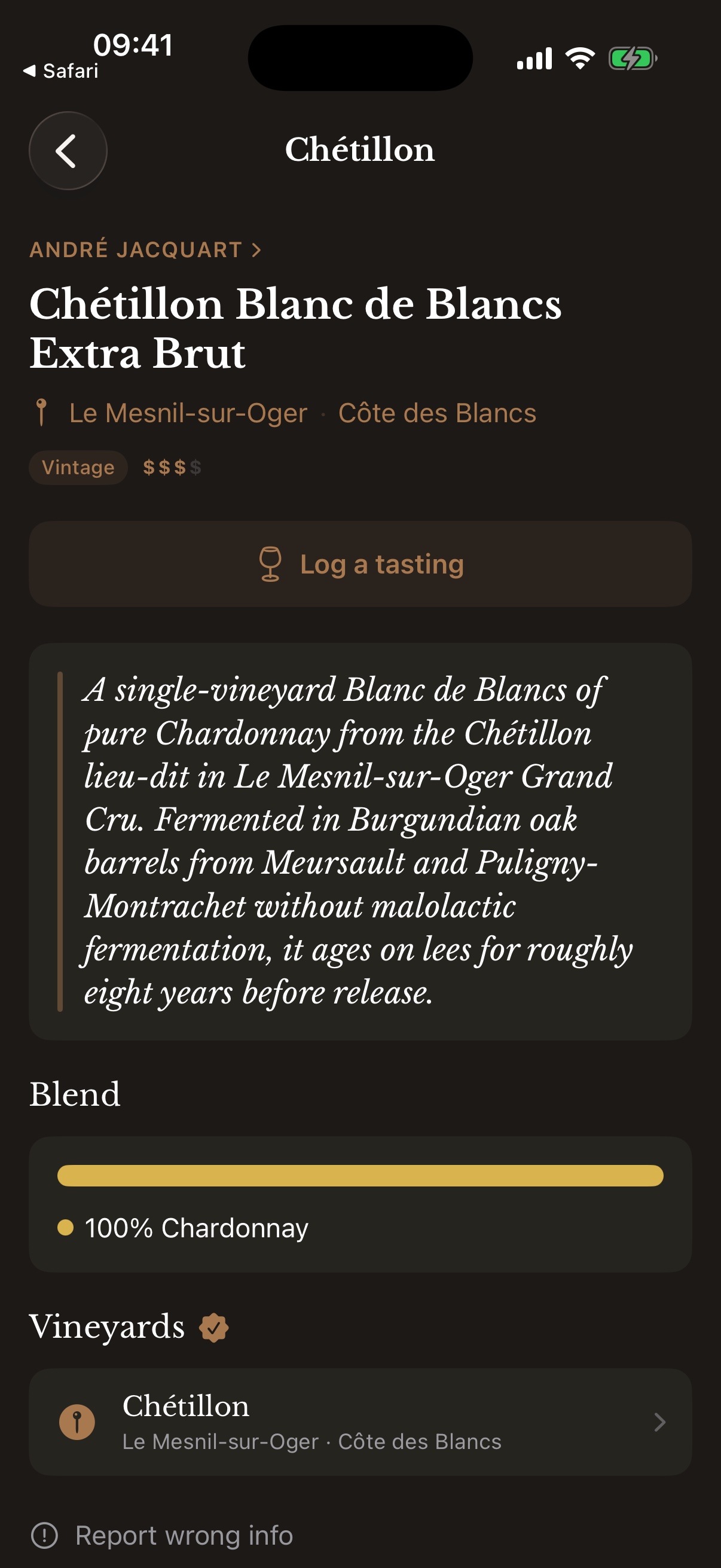
From vineyard to bottle Trace the journey from parcel to champagne. See which houses and growers source from each vineyard , and trace any bottle back to the parcels it came from. Our cuvée database grows continuously, with new bottlings added regularly.
Latest vintage weather Weather and climate data for the most recent vintage , rainfall, sunshine, and growing degree days.

Costs less than what you opened last weekend.

Membership

Read between the vines.

Membership brings predictive analysis to every vineyard. Performance scores for every vintage since 1950, climate projections, vineyard comparisons, and tools to discover parcels with the same terroir fingerprint, or the same behaviour across decades.
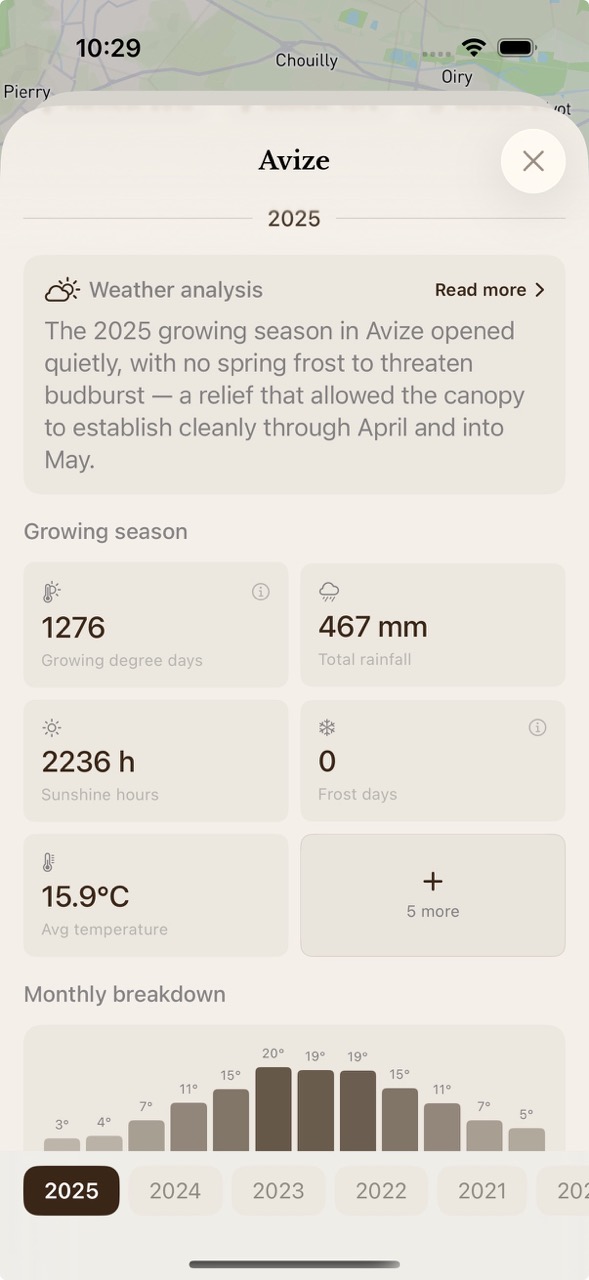
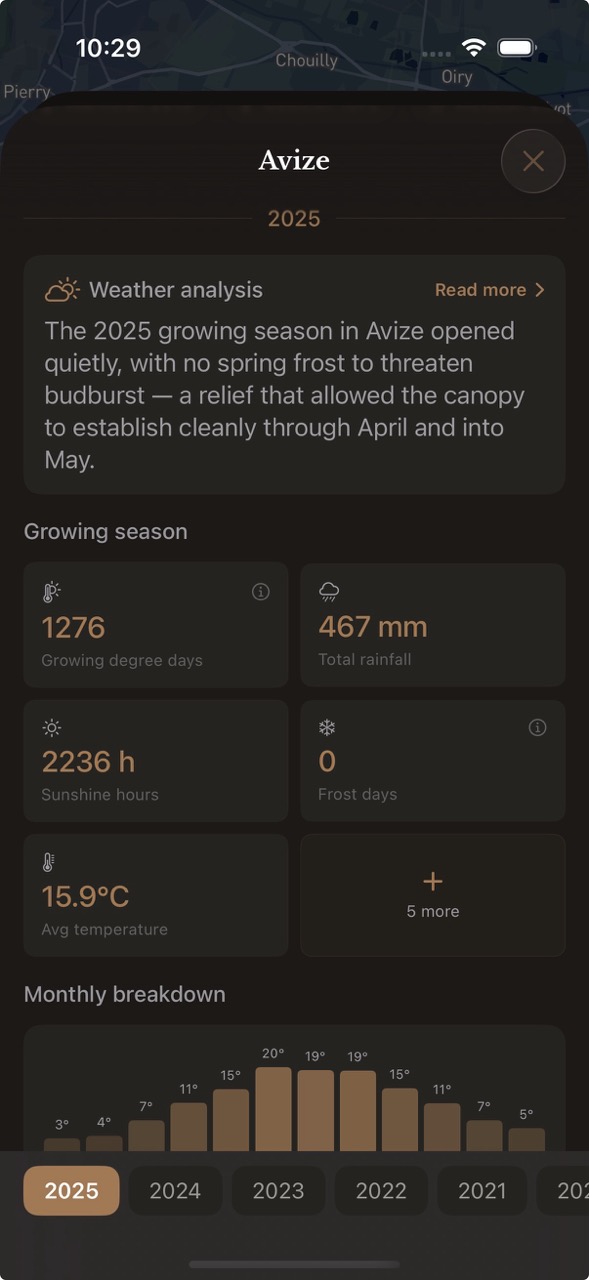
Season Tracker Season Tracker
Decades of climate data Decades of climate data
Vintage Scores Vintage Scores
Vineyard comparison Vineyard comparison
Terroir Twins Terroir Twins
Expert overlays Expert overlays

Season Tracker

Follow the current growing season village by village. GDD accumulation, rainfall, 3-day weather forecast, frost warnings, harvest predictions, and season archetype probabilities , updated daily from April through October.

Bookmark your villages and watch the season unfold. A warm-dry pattern in the Montagne de Reims doesn’t mean the same for the Côte des Blancs.

Decades of climate

Growing degree days, rainfall, and sunshine decade by decade since 1950. See how climate has shaped the vines , and which trends are accelerating.

1976. 2003. 2018. Three record-breaking summers, decades apart. The data shows which parcels weathered each one best.

Vintage Scores

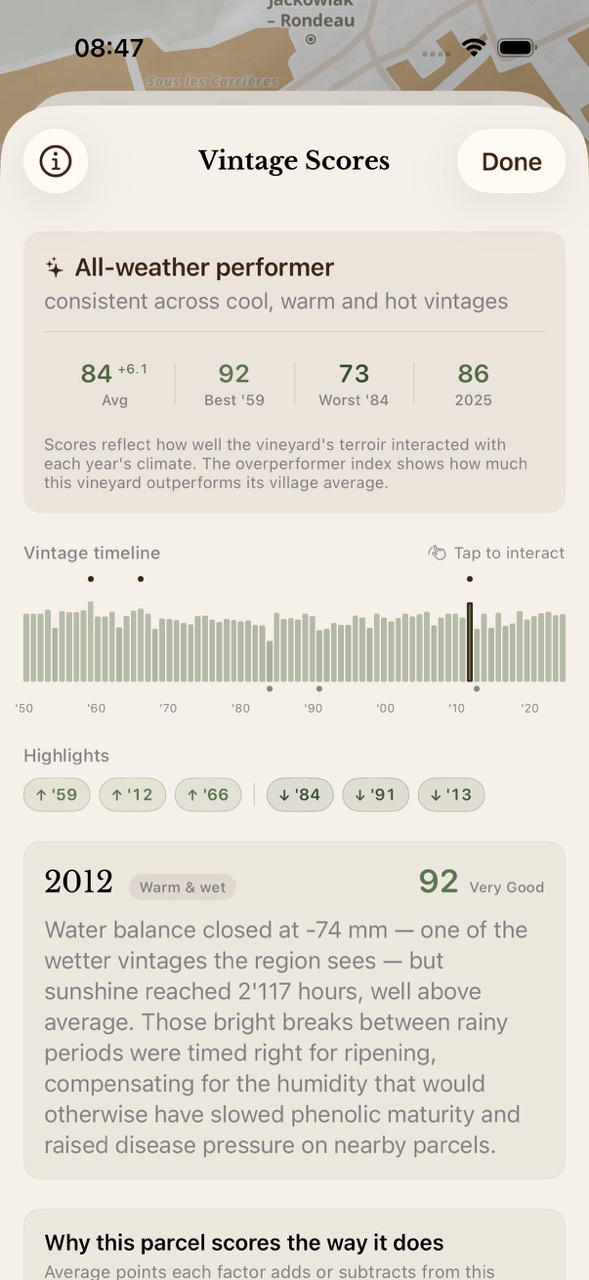
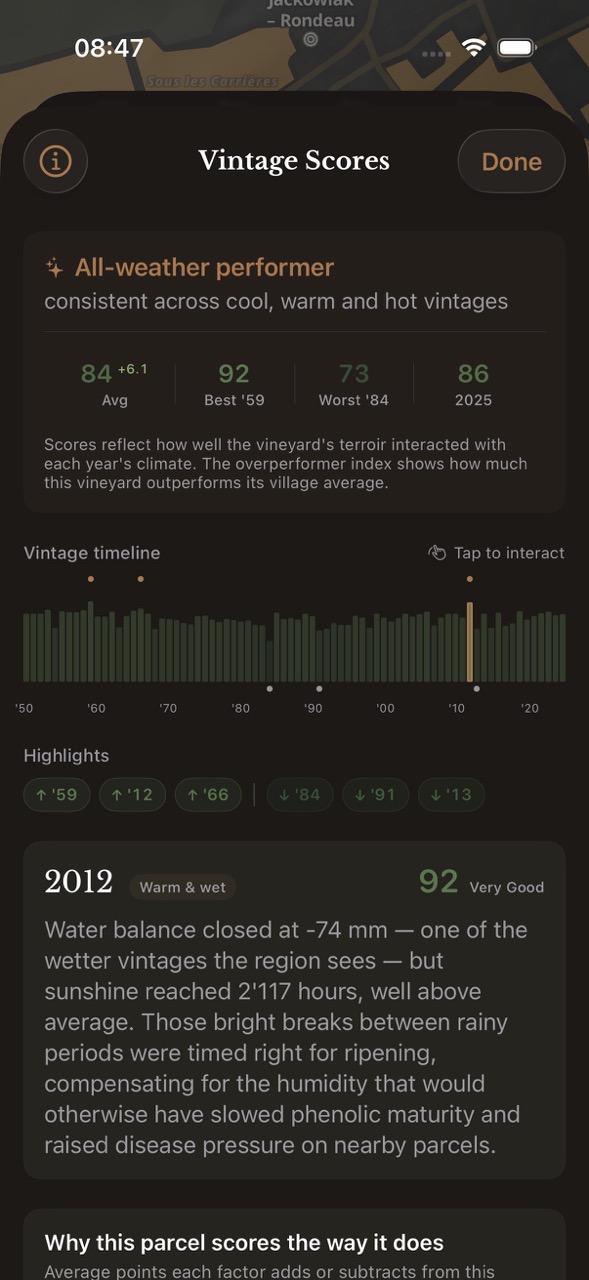
Not every vineyard handles the same weather the same way. Every parcel is scored against every vintage since 1950, revealing which plots thrive in heat, which ones need cool years, and which deliver regardless.

The 2003 heatwave destroyed some parcels and elevated others. Now you can see which, and why.

Compare up to 10 vineyards

Pick any combination of parcels and see them side by side , terroir, climate, scores, geology. Every metric in one unified table, exportable as a detailed PDF.

Clos du Mesnil vs. Clos d'Ambonnay. Same classification, different terroir. The comparison tells the story the label can't.

Terroir Twins

Two ways to find similar vineyards. Looks like matches on physical attributes , aspect, slope, altitude, soil. Performs like matches on behaviour: which parcels reacted the same way across decades, regardless of what's underneath.

Find the undiscovered twin of your favourite vineyard. Same terroir fingerprint, a fraction of the fame.

Expert overlays

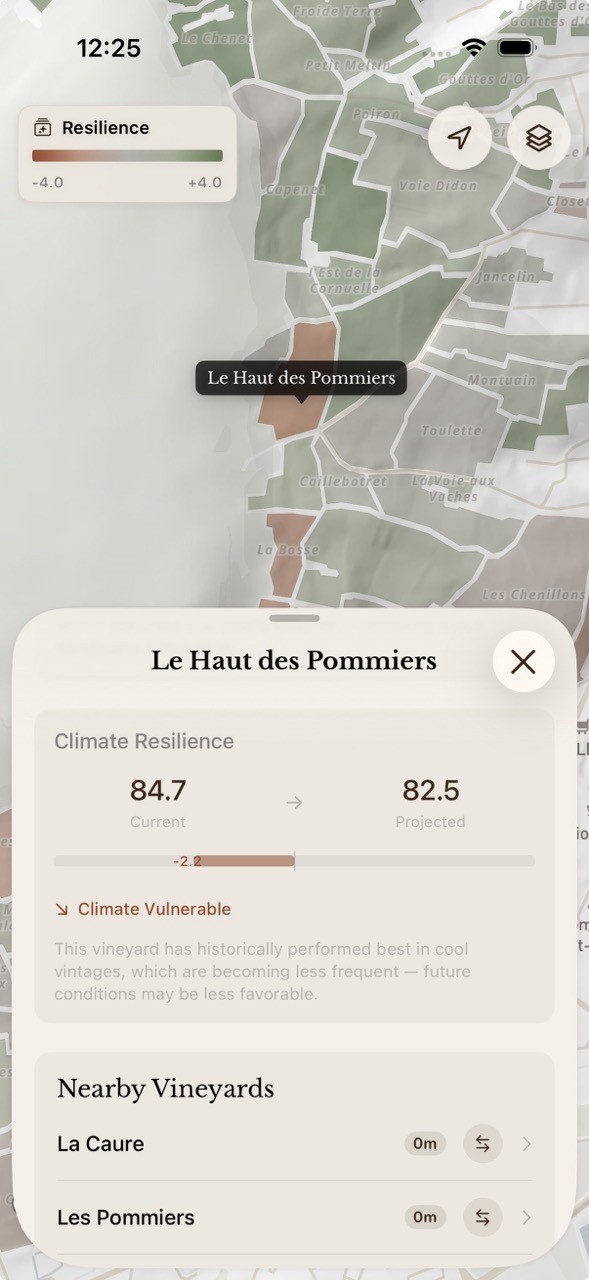
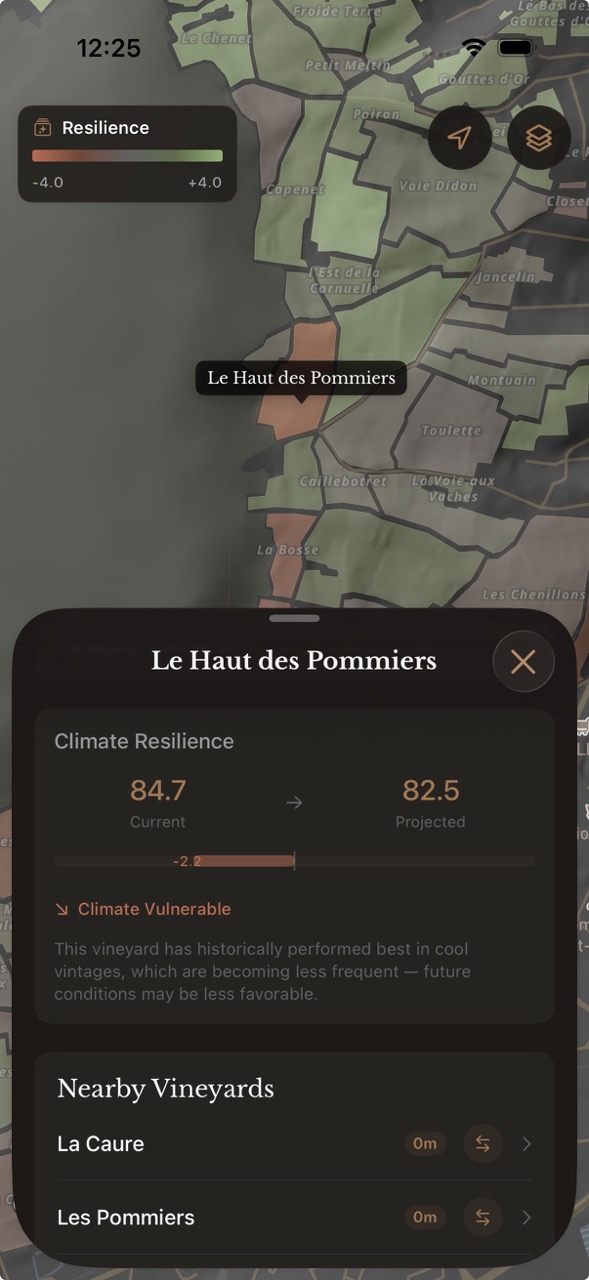
Read the same map through different lenses: long-term track record, terrain physics like solar exposure and frost drainage, climate projections through 2040, and per-variety resilience for Chardonnay, Pinot Noir, and Meunier, because each grape faces a different future.

Switch the lens, change the story. A vineyard’s terrain advantage in one overlay can read as a frost trap in another, and a Pinot Noir stronghold in a third.

Village vintage breakdown Quality scores for every village and vintage, derived from weather data and grouped by subregion.
PDF & Excel exports Terroir reports, comparisons, and data tables, ready to share, present, or archive.
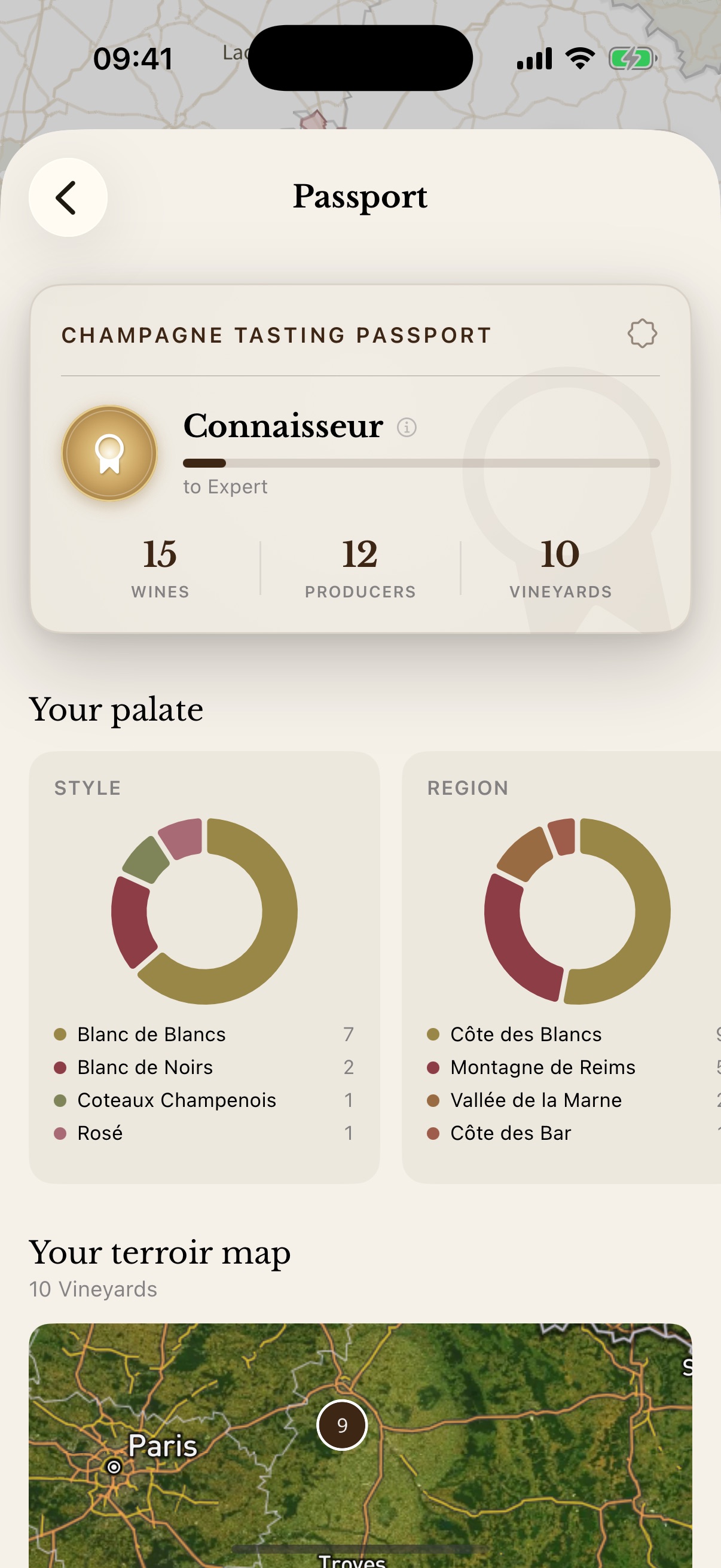
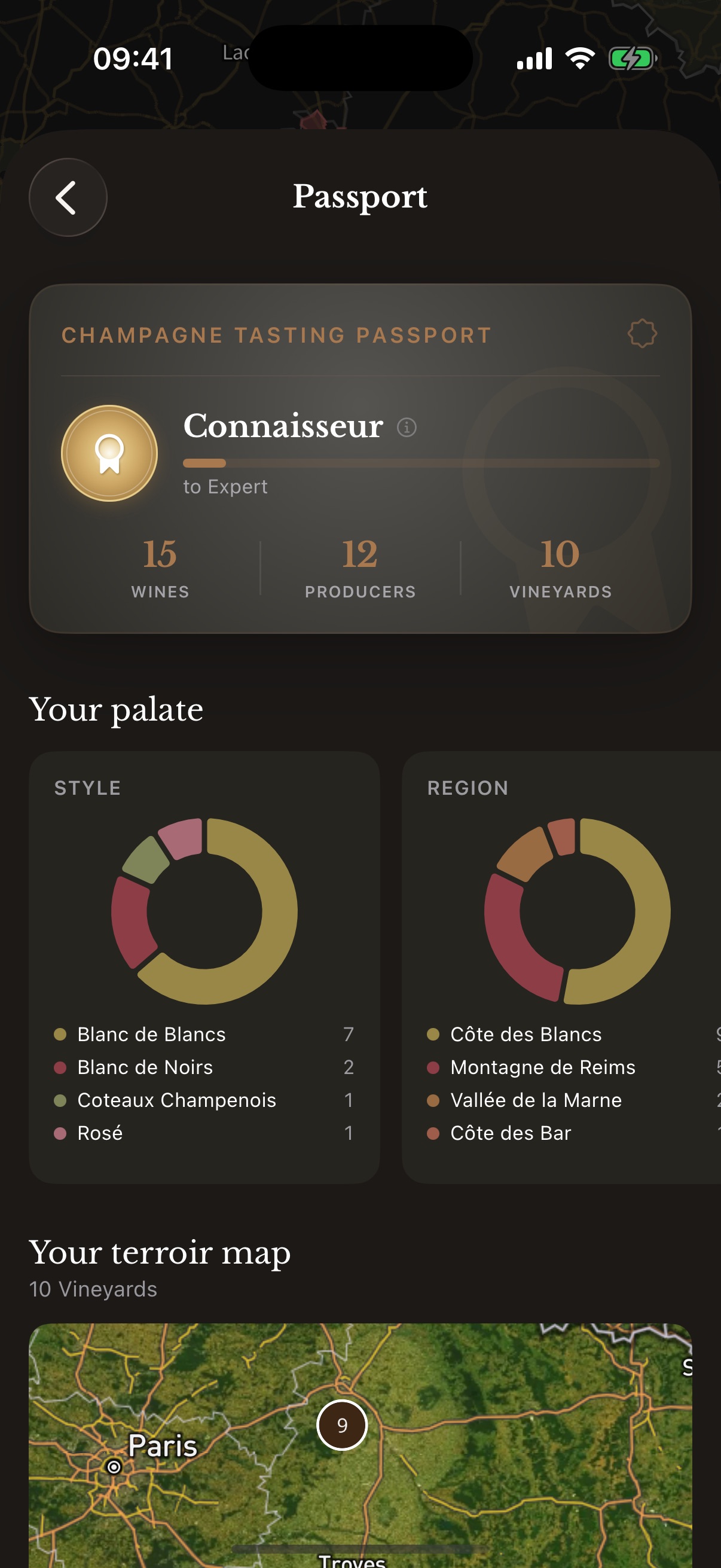
One membership, everything included Every feature and every dataset is part of your membership, always up to date. New vintages, new bottlings, and refined climate records arrive automatically.

One membership. Every layer of Champagne, always up to date.

Included with Membership

Champagne is warming.

Seven decades of weather observations meet state-of-the-art climate models. See exactly how the region is shifting, and what it means for the wines of the future.

Cool Warm & Wet Warm & Dry Heatwave
1960s
1970s
1980s
1990s
2000s
2010s
CMIP6 projections ↓
2030s
2040s
56% → 0% Cool vintages have nearly disappeared since the 1960s, and projections show they won’t return.
+270 GDD Growing degree days have risen steadily across all 7 subregions, with Montgueux warming fastest.
2040s CMIP6 projections through the 2040s show Champagne shifting from ‘Very cool’ to ‘Cool’ on the Huglin Index.
Climate Resilience
Chardonnay +54 Resilient
Pinot Noir +31 Moderate
Meunier +18 Moderate
Headroom: +180 GDD · Buffer: High (chalk)
Projected Performance
83.9 87.1
Improving
Current Projected
+3.2

Climate Resilience scores every vineyard per grape variety, based on elevation, aspect, and soil. See which parcels are structurally built for what's coming.

Included with Membership

The season, tracked.

From budburst to harvest, follow the growing season as it happens. GDD accumulation, rainfall, frost and hail events, 3-day weather forecast, season archetype probabilities, and harvest predictions, updated daily for every village in Champagne.

Daily GDD, rainfall, and risk events updated daily from weather station data throughout the growing season.
4 archetypes Each season is classified against four vintage archetypes, cool, warm & wet, warm & dry, or heatwave, with live probability shifts.
Season Pulse Your season at a glance, warmth status, GDD, frost warnings, harvest predictions, and subregion summaries on a single home-screen card.
Season Tracker 82% of season
Ambonnay Frost ahead
Very warm 1420 2
11 Sep (72%)
Avize
Warm 1380 1
14 Sep (68%)
Subregions
Côte des BlancsWarm 1385 Montagne de ReimsWarm 1402 Vallée de la MarneAverage 1310
Vintage Archetype Outlook
Warm & dry 71%
Heatwave 18%
Warm & wet 7%
Cool year 4%
Closest analog year: 2018

Based on GDD trajectory similarity up to today

Harvest Prediction High
11 Sep
9 Sep 14 Sep

Based on historical GDD-at-harvest thresholds. Confidence improves as the season progresses.

GDD heartbeat A cumulative growing-degree-day curve plotted against the historical envelope from 1950. See at a glance whether the season is running warm, cool, or in line with the long-term norm.
Bookmark & monitor Save your favourite villages and track them from the home screen. The Season Pulse card surfaces warmth status, recent frost and hail alerts, and subregion summaries at a glance.
Harvest prediction An estimated harvest window derived from historical GDD-at-harvest thresholds, narrowing as the season progresses. Confidence levels, earliest and latest bounds, and the closest analog vintage are all included.
Seven-day weather log Daily highs, lows, precipitation, sunshine hours, and weather codes for the past week, so you can see exactly what each village has been through.

Projections are based on statistical models using decades of historical weather data. They are for informational purposes and do not constitute viticultural advice.

Start free. Go deeper with Membership.

Free

CHF 0

No account needed

  • Explore over 8,000 vineyard parcels
  • Interactive map with vineyard boundaries
  • Subregion & village browsing
  • Vineyard classification & area details
  • Multiple map styles (cartography, standard, satellite)

Prices shown in Swiss Francs (CHF). Actual prices may vary by country and are determined by the App Store.

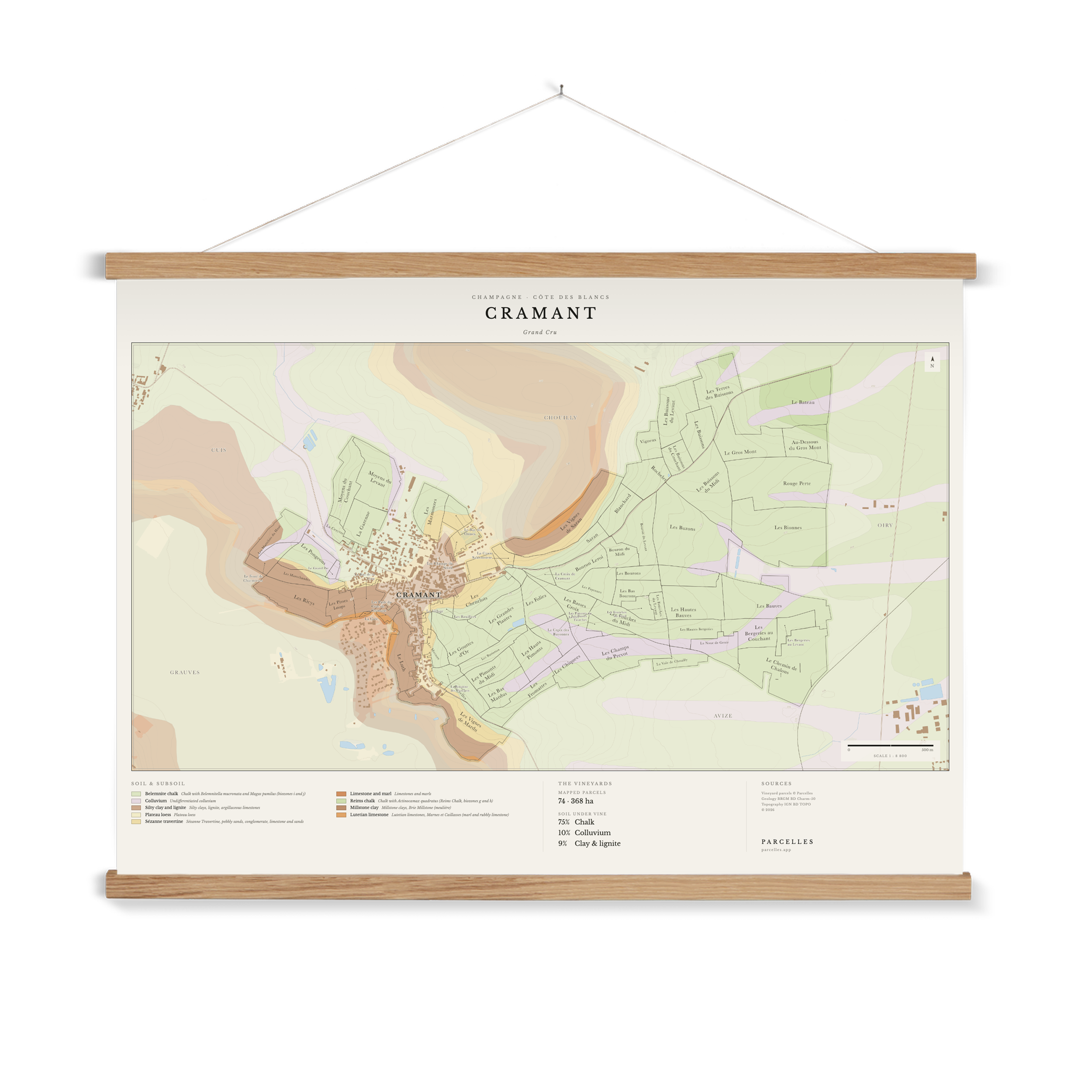
Vineyard poster, Clos des Goisses, Premier Cru

Your favorite vineyard, printed

Pick any vineyard in Champagne. We turn it into a museum-quality A1 giclée print on heavyweight matte art paper, mounted with a solid oak wood hanger with magnetic fastening and a color-coordinated hanging cord.

Printed with water-based inks on sustainably sourced paper and wood. Vegan-friendly. Shipped in rigid cardboard tubes with eco-friendly packaging.

Order a print of any vineyard in Champagne, made to order and shipped worldwide.

Order prints separately
Your vineyard in 3D We're exploring the idea of offering 3D terrain models (STL files) of Champagne vineyards, perfect for 3D printing, CNC milling, or just geeking out over topography. Interested? Let us know.
I'm interested

Why I built Parcelles

Champagne has over 8,000 vineyard parcels, each shaped by millions of years of geology, unique microclimates, and centuries of winemaking tradition. Yet there was no single place to explore this data. It was scattered across government archives, academic papers, and local knowledge passed down through generations. I built Parcelles to bring it all together, so that anyone with a curiosity for Champagne can understand what makes each vineyard unique, from the chalk beneath the soil to the bottle in your hand.

Roman Blum

Roman Blum

DipWSET