 Parcelles
In the 1960s, more than half of Champagne's growing seasons were cool years: long, marginal seasons where ripeness was a race against autumn. In the 2010s, about one season in twenty qualified. The kind of vintage that defined Champagne for most of its history has, in a single working lifetime, nearly disappeared.
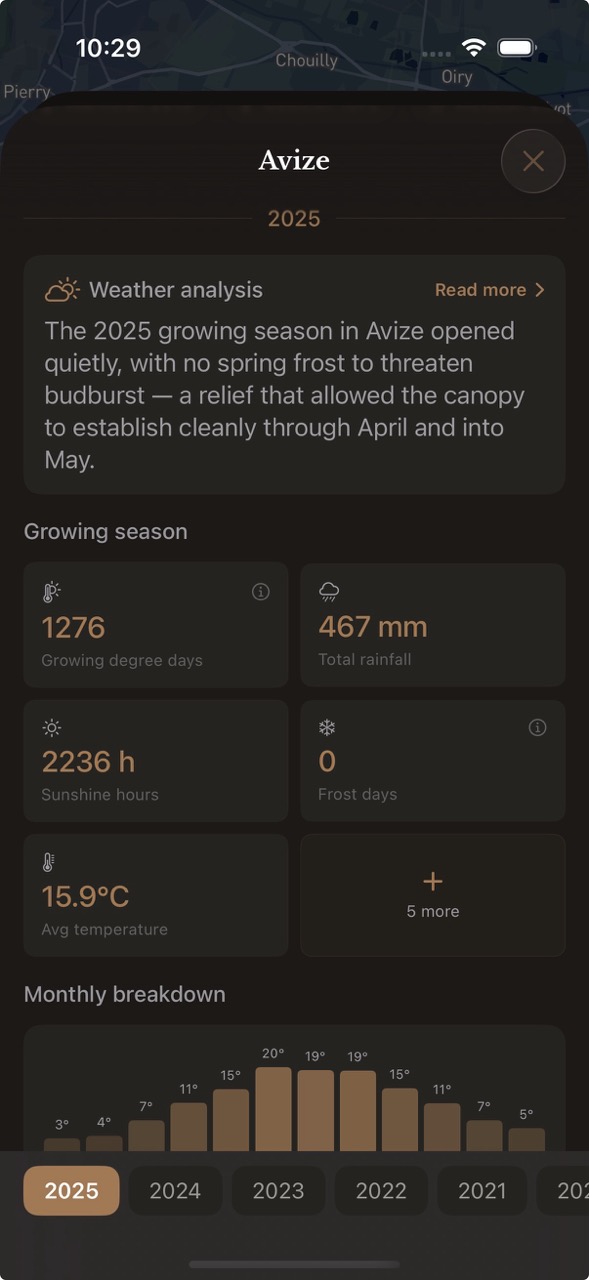
That is not a talking point about the future of the planet. It is visible in the harvest calendar, in the press houses, and in the numbers every grower lives by. Picking dates have moved roughly two weeks earlier than in the 1980s. Sugar levels that once needed help from the chaptalization tank now arrive on their own. And the question quietly circulating in the region has shifted from "will it ripen?" to "how do we keep the freshness?"
Built on the edge of ripeness
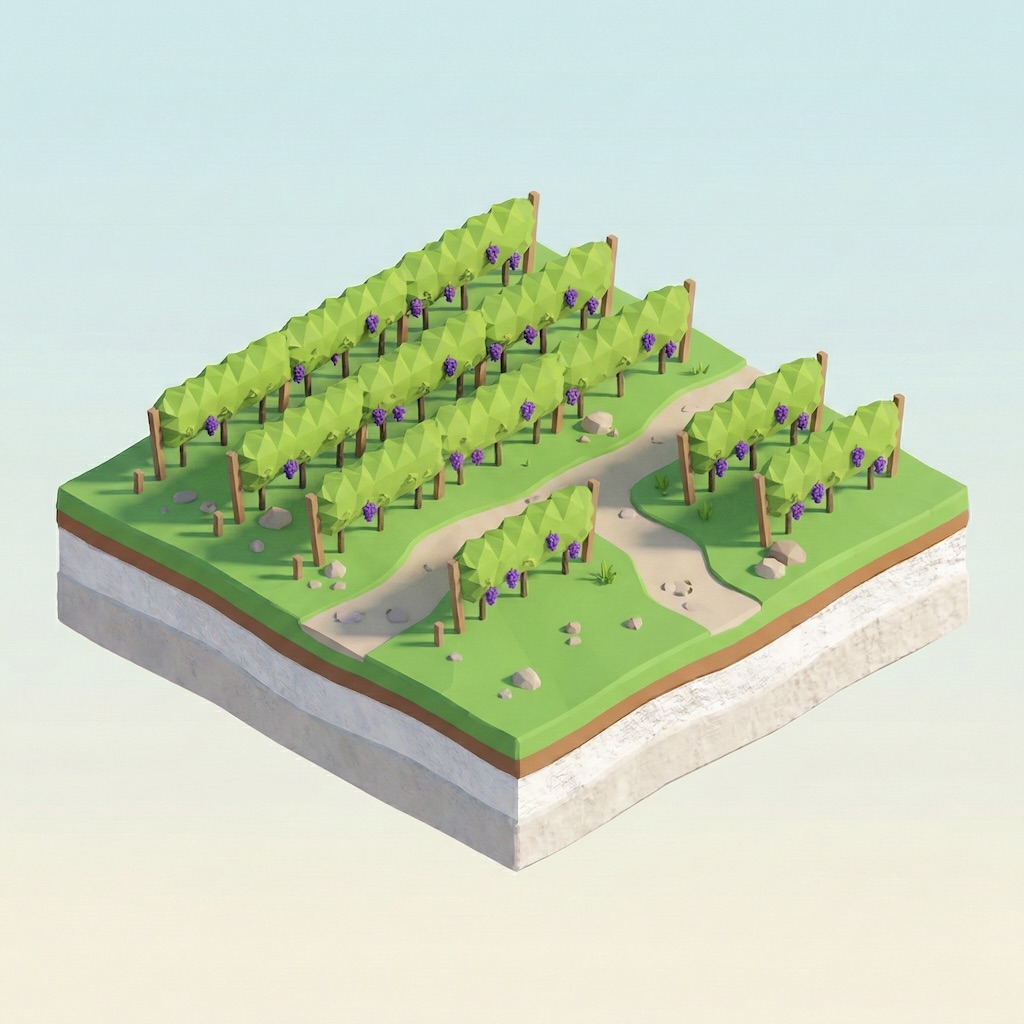
Champagne exists where it does because of a happy accident of marginality. At roughly 49 degrees north, it has long been one of the coldest places on earth where vines can ripen at all. Grapes here historically reached harvest with modest sugar and searing acidity, a fault for still wine and a gift for sparkling. The chalk beneath the vineyards does the rest: it drains rain away in wet years and feeds water back to the roots in dry ones.
Everything the region is known for, the tension, the low alcohol, the ability to age for decades, comes from that cool starting point. Which is exactly why a warming trend matters more here than almost anywhere else in the wine world. Champagne does not have ripeness to spare in reserve; it has acidity to lose.
Four kinds of season
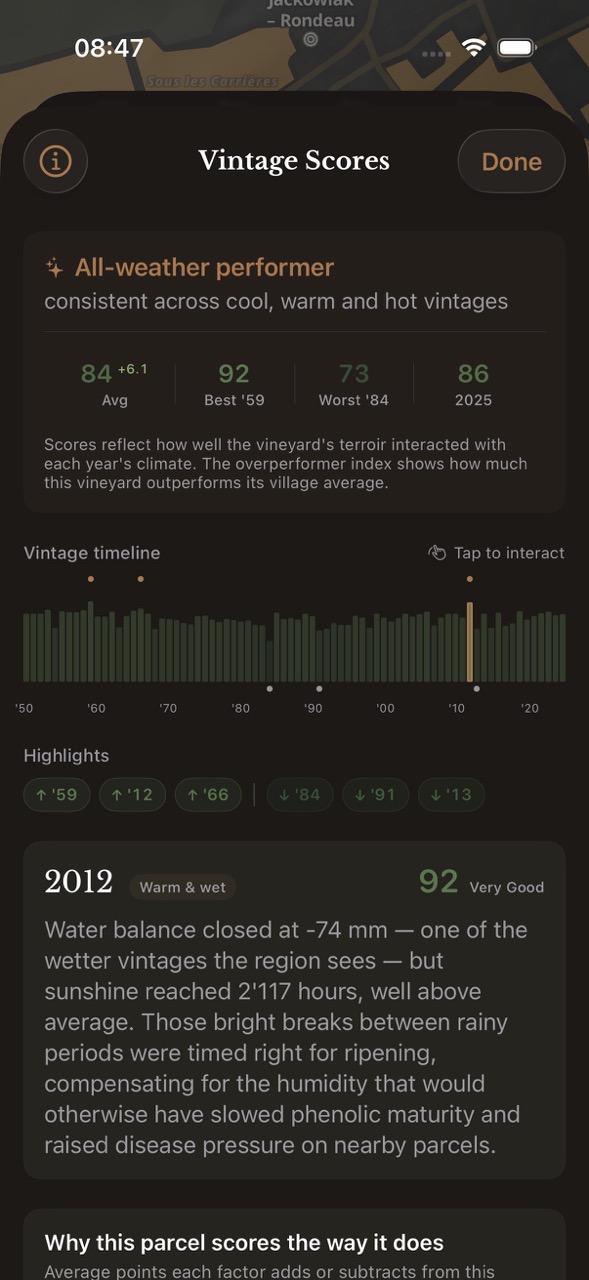
Averages hide what growers actually experience, so Parcelles classifies every growing season since the 1950s into one of four archetypes, based on the warmth it accumulated and the rain it received. A season is not "0.8 degrees above normal"; it is a kind of year, with a recognizable personality in the vineyard and in the glass.
The classic Champagne season: a slow, marginal ripening race. High acid, low sugar, and the style the region was built on.
Generous warmth with generous rain. Vigorous canopies, disease pressure, and a season won or lost in the spray program.
The new normal: ripe, healthy fruit, early harvests, and acidity that needs protecting rather than taming.
Extreme heat and water stress. Sunburn, blocked ripening on young vines, and harvests that start in August.
Seen through these four lenses, the story of the last sixty years stops being a gentle slope on a temperature chart and becomes something more blunt: one archetype is dying out, and another is taking its place.
Six decades of drift
Stack the decades side by side and the drift is unmistakable. Cool seasons made up 56 percent of the 1960s. They fall in every decade that follows: under half in the 1970s, about a third in the 1980s, a quarter in the 1990s. By the 2010s they are a rounding error, while Warm & Dry has become the most common kind of Champagne year and full heatwave seasons, once a freak event, account for a quarter of the decade.
- 1976
- An early warning: a drought season so hot the harvest began on the first days of September, then still an oddity.
- 2003
- The template heatwave. Picking started in August for the first time since 1822, and the region wrote its playbook for extreme years.
- 2018-2020
- Three consecutive warm, dry, early seasons. What the 1960s would have called exceptional had quietly become consecutive.
What the models say
Projections are not predictions, and any honest chart of the future should say so. But the CMIP6 ensemble, the same generation of climate models behind the IPCC's current assessments, is unambiguous about the direction. Downscaled to Champagne, the models put the 2030s and 2040s deeper into Warm & Dry territory, with heatwave seasons approaching one year in three and the classic Cool season effectively extinct.
On the Huglin Index, the scale viticulturists use to match grape varieties to climates, the models move Champagne from "very cool" to simply "cool" through the 2040s. That single step may sound small. It is the difference between the climate that made Champagne and the climate Burgundy had a generation ago.
The models do not describe a different planet. They describe Champagne with the climate Burgundy had a generation ago.
What it means for the grapes
A warming region does not suffer evenly, and neither do its grapes. Chardonnay handles the shift best: it buds early but ripens on a schedule that tolerates heat, and on chalk it keeps acidity remarkably well. Pinot Noir sits in the middle, rewarded by warmth up to a point and increasingly pushed past it on the warmest slopes. Meunier, long valued precisely because it shrugged off frost in cool years, has the least headroom as seasons turn hot and dry.
Terroir turns out to be the region's quiet insurance policy. Chalk buffers drought. North-facing slopes, long the consolation prizes of the classification, are becoming assets. Higher, cooler villages that struggled to ripen in the 1970s now land in the sweet spot. The map of what counts as a great site in Champagne is being redrawn, slowly, by the weather itself.
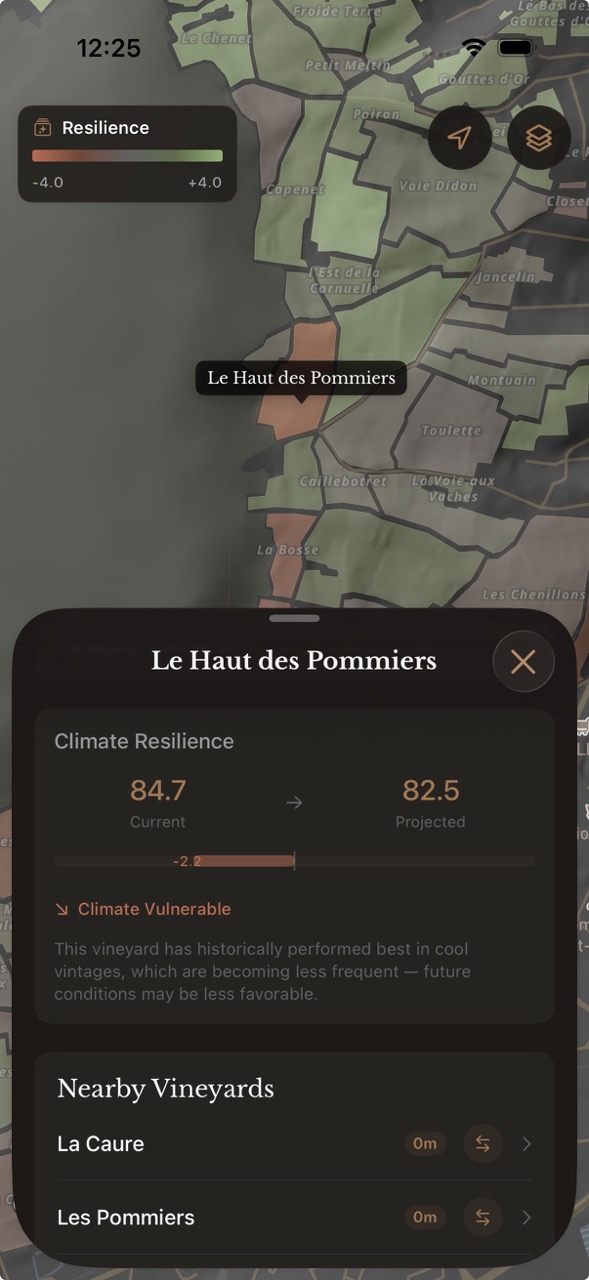
None of this is lost on the growers. Harvest logistics, pressing choices, reserve wine policies, even the debate about hybrid varieties and the slow rehabilitation of forgotten grapes like Arbane and Petit Meslier: the region is adapting faster than its image suggests. The wines are changing too, riper and rounder than their grandparents, which is precisely why understanding each site's resilience now matters more than its historical reputation.