 Parcelles
In April 1911, growers in the village of Aÿ set fire to the cellars of merchants they accused of making "champagne" from grapes carted in from outside the region. Cavalry was garrisoned in the vineyards. The crisis had been building for years: miserable harvests, collapsing grape prices, and a growing fury that the people who grew the fruit had no say in what it was worth. Out of that fury came, among other things, a list.
The list ranked every wine-growing village in Champagne on a percentage scale, and it survives today as the region's most famous, most misunderstood piece of vocabulary. When a label says Grand Cru, it is quoting that list. To understand what the words actually promise, you have to understand what the list was for. It was not written to describe soil. It was written to settle a price war.
A ladder of prices, not of terroirs
The system was called the échelle des crus, the "ladder of the growths", and it worked like this. Each year, growers and merchant houses negotiated a single price for a kilogram of grapes. A village rated 100 percent received the full price. A village at 90 percent received nine tenths of it, and so on down the ladder. Your address was your paycheck: every grower in a village got the village's rate, whether their vines stood on the finest mid-slope chalk or on the flat by the road.
Born in 1911 and refined over the following decade, the ladder was, in its way, a brilliant social invention. It gave growers a guaranteed, transparent price at a time when they had none, and it tied that price to a collective judgment about quality that everyone could point to. What it was not, and never claimed to be, was a survey of terroir. The judgment was commercial: which villages' grapes did the great houses want most, and what premium were they willing to commit to on paper?
The seventeen
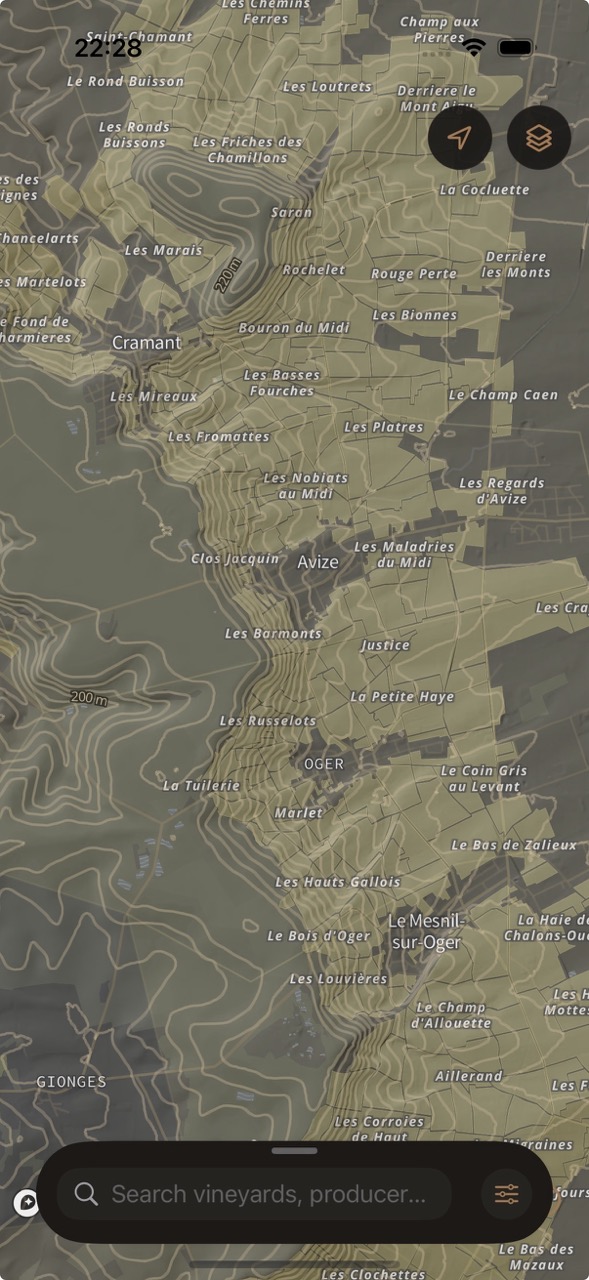
For most of the scale's life there were twelve villages at 100 percent. In 1985 five more were promoted, Chouilly, Le Mesnil-sur-Oger, Oger, Oiry, and Verzy, bringing the club to its current seventeen. They cluster where you would expect: the Pinot Noir strongholds of the Montagne de Reims and the Grande Vallée, and the Chardonnay spine of the Côte des Blancs. No village in the Aube, and none in the Vallée de la Marne west of the Grande Vallée, has ever held the rank.
Look closer and the neat 100 percent hides a wrinkle the labels never mention: several villages were rated differently for white grapes and black. Chouilly is Grand Cru for Chardonnay but was rated Premier Cru for Pinot Noir; Tours-sur-Marne the exact reverse. The ladder, in other words, already knew what every grower knows: a village is not one terroir, and a rank that flattens grape, slope, and soil into a single number is doing a lot of rounding.
Villages, not vineyards
Here is the choice that makes Champagne's classification unlike almost any other: it ranks communes, not plots. Burgundy went the other way, walking its hillsides parcel by parcel until a Grand Cru could be seven hectares with a fence around it. Champagne drew its lines around entire villages, ordinary flats and brilliant slopes alike. A Grand Cru village contains vineyard land that would struggle for Premier Cru status anywhere honest, and plenty of 89 percent villages hide mid-slopes that outclass their rank every warm year.
The scale also enshrined some judgments that look stranger with time. Verzenay, one of the original twelve, ripens Pinot Noir on slopes that face north, away from the sun, a heresy by textbook logic that happens to produce some of the most sought-after black grapes in the region. The ladder was right about Verzenay for reasons it never articulated. It was simply recording where the houses insisted on buying, and the houses knew things the textbook did not.
The échelle never measured terroir. It measured desire: where the great houses insisted on buying, and what they would commit to paper to get it.
What Grand Cru means on a label today
The pricing mechanism died in 1990, when the fixed regional grape price was abandoned, and the scale itself was formally retired two decades later. What survives is the vocabulary, now written into the appellation rules: a champagne labeled Grand Cru must be made entirely from grapes grown in the seventeen 100 percent villages; Premier Cru, entirely from the 59 villages ranked 90 percent or above. That is the whole promise. It says where the grapes grew, at village resolution, and nothing else: not the slope, not the soil, not the grower's ambition.
Which is not to say the words are empty. The seventeen earned their rank across a century of harvests, and the concentration of great sites inside them is real. But the interesting truth is one step finer than the label: the rank tells you the village, and the village is where the story starts, not where it ends. The difference between two parcels in Ambonnay can be the difference between two ranks anywhere else.