 Parcelles
Monts de Berru
Chardonnay's isolated outcrop.
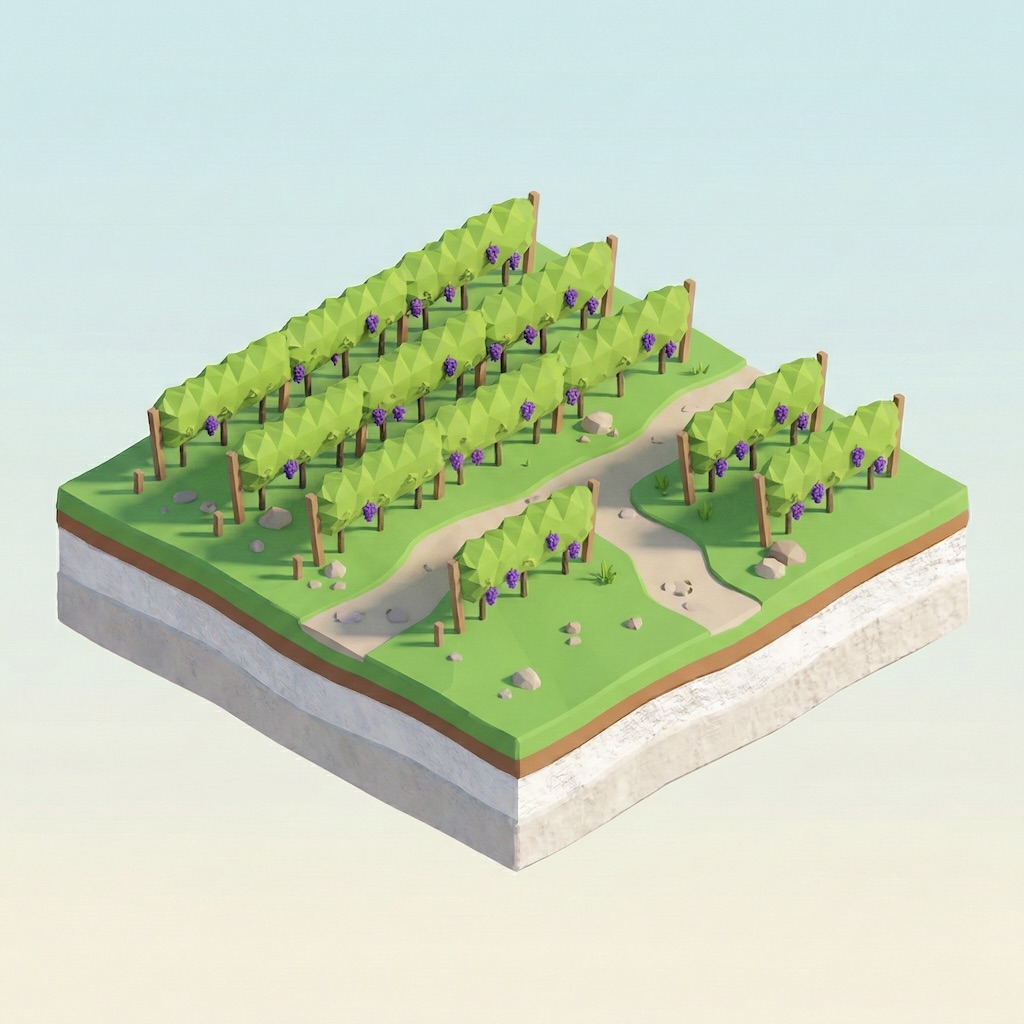
Monts de Berru is the smallest terroir of the Montagne de Reims, a cluster of just five villages gathered around an isolated hill east of Reims. Geologically the Mont de Berru is a butte témoin, a detached outlier of the Montagne de Reims plateau, cut off from the main massif by the valley of the Vesle. That isolation matters: the hill never built up the thick clay cap that covers the upper slopes of the main escarpment further south, so its vines sit close to bare Cretaceous chalk, the same white subsoil that defines the Côte des Blancs. The chalk here is old and exposed enough that the hill is also a documented fossil site, with dozens of early mammal species recovered from its slopes. Chardonnay responds to that chalk much as it does around Épernay, and it makes up the large majority of plantings here, an unusually high share for a corner of the otherwise Pinot-Noir-dominated Montagne de Reims. The area's clearest historical marker is carried in a place name rather than in the vines. Pontfaverger-Moronvilliers, one of the five member villages, takes its second half from a village that no longer exists. Moronvilliers stood at the edge of the wooded hills fought over east of Reims in April and May 1917, in what is known as the Battle of the Hills, part of the French Fourth Army's supporting attack for the Nivelle Offensive. German troops had occupied the village since September 1914, and it was levelled by the war's end. Unlike many Champagne villages that were rebuilt after 1918, Moronvilliers was not: it was classified a zone rouge, land judged too damaged to reconstruct, and in 1950 what remained of its territory was folded into neighbouring Pontfaverger, which took the combined name it still carries today. It is a small, sobering footnote for a terroir that otherwise leaves little trace in the historical record.
Subregion: Montagne de Reims
View on the map →Villages
Go deeper with the Parcelles app
Terroir, vintages since 1950 and the story behind every champagne — on the interactive map of every parcel in Champagne.